


 By
Around the twelfth minute of a steady walk on the treadmill, almost everyone begins to bargain with the clock. You look at the calories. You look at the time. You wonder why one screen can move so slowly.
A Hiit training treadmill workout solves this in a way no playlist ever has. You stop waiting for the workout to finish and start counting down to the next interval. I have already compared HIIT directly with Pilates and Barre in my full-body workout comparison, and HIIT easily won the cardio round.
This is the treadmill version of that story: what to set, how long to continue, and the three mistakes that quietly change your intervals into a slightly faster jog.
Quick answer
A HIIT treadmill workout consists of alternating between 30 to 90 seconds of intense, high-effort activity and periods of easy recovery. The session should begin with a 5-minute warm-up and conclude with a cool-down. Beginners can start with 8 rounds, each comprising 30 seconds of high-effort activity followed by 60 seconds of rest. If you prefer not to run, walking briskly on an incline is just as effective. Perform this workout twice a week, ensuring at least one day of rest between sessions. Additionally, make only one change at a time.
What a hiit training treadmill workout actually is
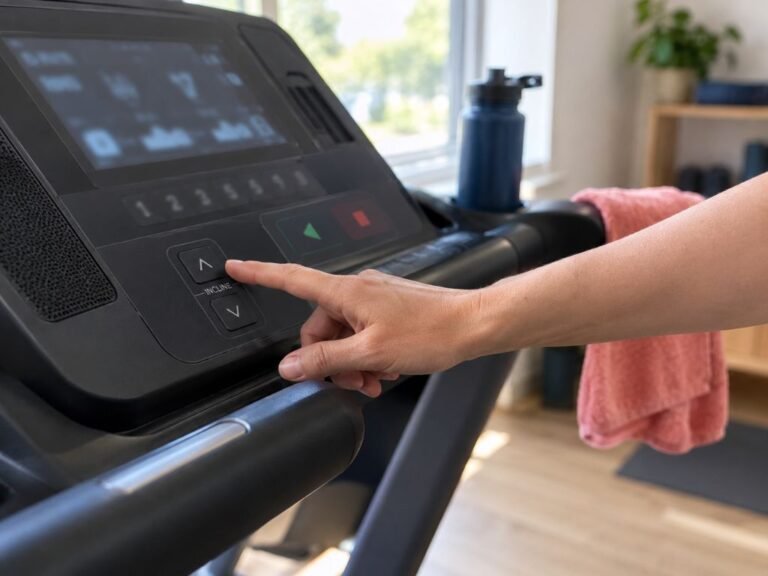
High-intensity interval training replaces one steady pace with a cycle of hard effort and easy recovery. On a treadmill, you have two controls to increase for the hard part: speed and incline. That second control is more important than people think. A hard interval does not need to be a sprint. Walking uphill on a steep incline is a real hard interval, and for many people it is the wiser choice.
Mayo Clinic describes high intensity as the point where you can speak only a few words before you need to take a breath. Its own example combines about 30 seconds of hard effort with one to three minutes of recovery, according to its Q and A on interval training.
I trust that talk test more than any number on the console.
Why the treadmill is such a good place for intervals
The treadmill removes the guesswork. The belt keeps your speed, the console keeps track of the time, and the weather never cancels your session. It also makes progress easy to see. You can repeat the exact same treadmill HIIT workout next week and change only one number.
The one honest disadvantage is boredom during the easy parts, which is why I keep every plan below short and well-structured. A runner’s general rule is to set a 1 percent incline for easy running to compensate for the lack of wind, and I follow that rule.
How to set your speed without guessing
Fixed speeds are the weakest part of most treadmill plans. A pace that is a sprint for one person is a warm-up jog for another person. So I set mine according to effort. On a scale of 1 to 10, easy recovery is around a 3 or 4. The hard intervals are around a 7 or 8, where talking is almost impossible but your form is still good.
Treat the first session as a test. If you can finish the last hard interval at about the same speed as the first one, you chose well. If the last rounds fall apart, you started too fast. Write down your speeds afterwards. Next time you will have a starting point, and you can change one thing instead of guessing again.
Warm up and cool down first
Five minutes is the minimum. Start with an easy walk and increase the speed a little every minute until you feel loose and slightly warm.
Finish with three to five minutes of walking that slowly becomes slower. Then stand still for a moment before you step off, because your legs feel strange after hard intervals.
Four hiit treadmill workout plans for every level
All four follow the same rhythm: warm up, work, recover, repeat, cool down. Only the length and the intensity change.
| Plan | Time | Hard interval | Recovery | Best for |
|---|---|---|---|---|
| Starter walk-run | 20 min | 30 seconds, 8 rounds | 60 seconds easy | First-timers and comebacks |
| Incline walk | 25 min | 1 minute at 6 to 10% incline, 6 rounds | 90 seconds flat and easy | Low impact, no running |
| Classic intervals | 25 min | 45 seconds, 8 rounds | 75 seconds easy | Regular exercisers |
| Pyramid | 30 min | 30 to 90 seconds, 7 rounds | 2 minutes easy | Experienced exercisers |
Plan one: the starter walk-run (20 minutes)
Walk for five minutes, moving from an easy pace to a brisk pace. Then run, or walk very fast, for 30 seconds. Go down to an easy walk for 60 seconds and repeat the cycle eight times. Finish with three minutes of easy walking. Aim for about a 7 on the effort scale during the hard parts.
Week one is not about being completely exhausted. It is about finishing with the feeling that you could have done one more round.
Plan two: the incline walk with no running (25 minutes)
This one is for anyone who prefers walking, has sore knees, or simply wants a lower-impact option. Warm up for five minutes at a flat, easy pace.
Then increase the incline to somewhere between 6 and 10 percent, depending on what your legs can manage, and walk at a fast but controlled pace for one minute. Go back to flat and walk easily for 90 seconds. Repeat six times, then cool down for five minutes. Keep your hands off the rails if you can. Holding on allows you to lean back, and that reduces the work your legs are doing.

Plan three: classic sprint intervals (25 minutes)
Warm up for five minutes. Then run hard for 45 seconds and recover for 75 seconds, eight times. Cool down for four minutes.
For many people, the hard speed ends up somewhere between 6 and 9 mph, but your effort is more important than the number. Aim for about an 8, a pace you could maintain for maybe another 15 seconds and no longer.
Plan four: the pyramid (30 minutes)
Warm up for five minutes. The hard intervals then rise and fall: 30 seconds, 45 seconds, 60 seconds, 90 seconds, 60 seconds, 45 seconds and 30 seconds. Take two full minutes of easy walking or jogging after each one, then cool down for five minutes.
The 90-second effort in the middle is the hardest one. Hold back a little on it, because three more intervals are still waiting.
How often to do a hiit training treadmill workout
Two sessions a week is where I settle, with at least one day between them. Hard intervals make your legs sore in a way that easy cardio never does.
It is worth being honest about one thing. The hard parts of these workouts add up to only a few minutes. The CDC’s adult guideline is 150 minutes of moderate activity a week, or 75 minutes of vigorous activity, or an equal mix. So I treat HIIT as one part of the week, not the whole week.
My week includes two treadmill HIIT days, one or two strength days, an easy walk or low-impact session on another day, and a full rest day. On the days in between, my aerobic exercise to reduce weight routine keeps my heart rate up without the pounding. And if you wonder whether a slower class can ever feel hard, I explained that in is Pilates a high intensity workout.
Progress without overdoing it
Change one thing at a time. Add one round, or add five seconds to each hard interval, or increase the incline by 1 percent. Never do all three in the same week.
My rule is simple. When you finish a plan twice in a row feeling like you still had more energy left, move up. Staying with the same plan a little longer costs you nothing. Mayo Clinic builds progress in the same way, moving from two or three hard intervals to five or six, then making each one longer, to a minute or two.

The 3 mistakes that waste a treadmill hiit workout
Starting the first interval too fast
The first hard interval always feels great, which is exactly the trap. You choose a speed you cannot repeat, and by round five you are shuffling. Start one step below what feels possible. A hard effort you can repeat is better than a heroic effort you cannot repeat.
Cutting the recovery short
Recovery is not laziness. It is what allows the next interval to actually be hard. When you shorten the rest to feel tougher, the quality of every hard interval falls, and the whole session becomes one long medium effort.
Jumping on and off a moving belt
Some online routines tell you to stand on the side rails while the belt keeps running. I skip that. A stumble at speed is the risk that worries me most on a treadmill. Reduce the speed using the buttons instead, attach the safety key to your clothing, and use the rails only for balance when getting on or off.
Safety notes before you start
HIIT is hard work, and it is not right for everyone on the first day. If you have a heart condition, a long-term health problem or joint pain, or you are returning after a long break, talk to your doctor before adding intense intervals. Stop if you feel chest pain, dizziness or unusual shortness of breath. Wear supportive shoes, keep water within reach, and never skip the warm-up.
I am a fitness enthusiast sharing what works for me, not a medical professional, so treat all of this as general information.
Is a hiit training treadmill workout good for weight loss?
It can help, mainly because it uses a lot of energy in a short time and stays interesting enough that you actually repeat it. On the fitness side, a Mayo Clinic cardiac rehab director describes HIIT as a stronger stimulus for peak oxygen use than moderate steady exercise, in much less time, in this Mayo Clinic podcast episode.
Weight change depends on the whole picture: food, sleep, and how much you move across the week. HIIT is one tool in that picture, not a shortcut around it.
The one I would start with
If I could hand you one workout this week, it would be plan one. Eight rounds. Twenty minutes. Write down your speeds.
Next week, change one thing. That is how a hiit training treadmill workout turns from a dreaded session into the one you actually look forward to.
