


 By
You’ve seen the clip. Someone crouches low, explodes up, and lands on a tall box as if gravity took the day off. The caption makes it sound like anyone can do it. What it doesn’t say? Plyometrics build power fast, and they can hurt your knees just as fast if your body isn’t ready.
Stick with me to the end of this page and you’ll know what plyometrics actually are, what they can do for you, and whether today is the right day to start.
What are plyometric exercises, in layman's terms
Plyometric exercises are fast, explosive movements. A muscle stretches, then contracts right away. Jumping. Hopping. Bounding. Throwing. Those are the classics.
Squat jumps. Side-to-side hops. A clap push-up. Every one of them asks your muscles to load up in a hurry and then fire, hard. People call it jump training, too. Fair enough. But it isn’t only about legs. Throws and pushes count just as much.
Plenty of HIIT routines borrow plyometric moves like jump squats, for instance, which is exactly why people mix the two up. I dig into that overlap in my comparison of HIIT, Pilates, and barre.
How plyometric exercises work: the spring effect in your muscles

Picture a spring. Press it down fast, let go, and it snaps back harder than if you’d pressed it down slowly. Your muscles and tendons work a bit like that spring. Drop into a squat before a jump and they stretch, storing a little elastic energy. Switch direction fast, and you get to spend it.
Sports science has a name for this: the stretch-shortening cycle. Three parts. The loading phase, a very brief pause, and the push. That pause? It’s the whole secret. Linger at the bottom of the squat and the stored energy just… fades. The jump loses its pop.
That’s why plyometrics feel nothing like lifting. You’re not training how much force you can produce. You’re training how quickly you can produce it.
Examples of plyometric exercises for legs, upper body and core

Most people know the lower-body moves best. Squat jumps, box jumps, lateral jumps, forward hops, jumping rope, they all count. Jump rope is the sneaky favorite. The jumps are tiny, and your feet barely touch the ground.
For the upper body, you swap the legs for the arms. A wall push-up, hands briefly leaving the wall is the gentle one. The floor version, hands leaving the ground, is the advanced one. Medicine ball throws and chest passes live here too.
And the core? Fast rotational ball passes. Russian twists, done with speed and control. One word on difficulty. Harvard Health calls gym-style box and hurdle jumps advanced. Their advice: try them with a trainer, once you’ve built some skill and strength.
Benefits of plyometric exercises beyond athletics
Athletes use plyometrics to jump higher, sprint faster, and change direction on a dime. But the benefits aren’t locked behind a team jersey.
Harvard Health points to better coordination, agility, and flexibility as well, plus a heart-pumping workout in a short window. Here’s the older-adult research, and it’s worth knowing. A systematic review of randomized trials in people 60 and over found plyometric training feasible and safe. Possible gains in strength, bone health, and balance. And no study reported added injuries.
Those trials used carefully progressed programs. So no, this isn’t a green light to leap off the couch. Jumping loads your bones, too. A meta-analysis of jump training in adults found small gains in hip bone density. The clearest results showed up in younger adults.
How plyometric exercises differ from cardio, HIIT and strength training
Cardio keeps your heart working at a steady or rising effort for a while. Plyometrics are the opposite: short, sharp efforts, with real rest in between.
Here’s the distinction that clears up most of the confusion. HIIT is a format. Plyometrics are a type of movement. A HIIT workout can include jump squats, but it doesn’t have to. And you can do plyometrics without a single interval.
Strength training builds how much force you can produce. Plyometrics train how fast you can produce it. The two work well together, because a stronger base makes landing safer. WebMD notes that plyometrics aren’t classed as aerobic on their own. But repeat jumps for 30 to 60 seconds without a pause, and your heart rate will climb.
Are plyometric exercises right for you? A quick readiness check
This is the part I wish more articles spelled out. One major health site offers beginner-level plyometrics. Another says beginners should pick something else first.
Both are partly right. Because the real question isn’t whether you’re a beginner. It’s whether your body is ready for impact. A clinical overview in the International Journal of Sports Physical Therapy puts it plainly: a lack of foundational strength is a major reason to hold off. So here’s a simple self-check. Not a medical test. Just a few honest questions.
Can you do a bodyweight squat with control, knees tracking over your toes? Can you stand on one leg for about 30 seconds without wobbling? Any joint pain, swelling, or an injury that hasn’t fully settled? And do you have a soft place to land? Pass the first two, no pain, somewhere soft to land, start with the smallest version of a move. Hops a few inches off the floor, on a soft surface, for a handful of reps.
Hesitate on any of them? Spend a few weeks on basic strength and balance work first. That isn’t falling behind. It’s the shortcut that keeps you training.
Who should skip plyometric exercises or check with a doctor first
Check with your doctor first if you have joint problems in your knees, hips, or back. Trouble with balance. Heart or blood pressure concerns. Or a long stretch of inactivity behind you.
WebMD says to skip plyometrics during pregnancy. A shifting center of balance and looser ligaments raise the risk of a fall or injury. It also lists arthritis and diabetes-related nerve damage as reasons to choose something else. Hold off, too, with acute pain, swelling, a fresh sprain, or recent surgery, unless your clinician has cleared you. Clinical guidelines list all of these as reasons to wait.
And if jumping isn’t an option for you? That’s fine. There are lower-impact ways to build strength and stay active.
How to keep plyometric exercises safe
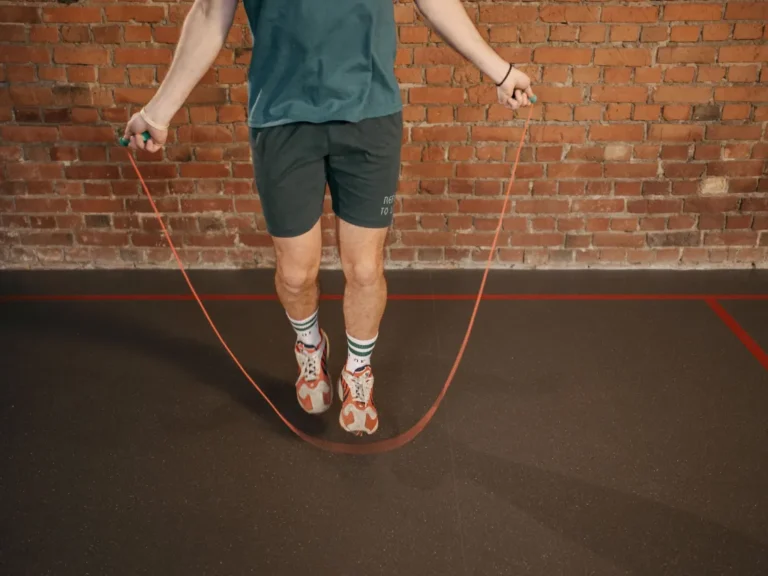
Surface comes first. Harvard Health recommends a thick, firm mat, a padded carpeted wood floor, or grass. Tile, concrete, and asphalt? Avoid them. And a thin yoga mat isn’t enough.
Keep jumps low. The higher you go, the harder you land. A few inches off the floor is plenty at the start. Land softly, knees bent. And don’t come down on only your heels, or only the balls of your feet. Warm up first. Wear cushioned shoes with good ankle support. And end a set the moment your landings get loud or sloppy.
Give your body time. Clinical sources suggest about 48 to 72 hours of recovery between sessions. That works out to two or three sessions a week, at most.
Where to start
Pick one move. Make it small. Five to ten little hops, a few inches off the floor, on a soft surface, with soft knees.
One to three sets. Rest between them. And notice how your knees and ankles feel the next day. Feeling good? Add a little at a time. Something feels off? Back up a step. Plyometrics reward patience far more than bravery.
