

 By
By The strong back advantage most lifters never unlock
Meet Daniel. He trains four days a week, never skips the gym, and has been lifting consistently for three years. His chest looks decent. His arms have some definition. But his back? It barely responds. His posture rounds forward at a desk, his pulls feel weak, and no matter how many rows he does, something just never seems to click.
If that sounds familiar, you are not alone.
The back is the most undertrained muscle group in most people’s routines – not because they avoid it, but because they never truly understand how it works. Most articles throw a list of exercises at you and call it a day. This one is different.
Inside, you will discover the best back exercises with dumbbells, organized through a framework that actually explains why your back grows – or why it has been stalling. Whether you are building a home gym routine or upgrading your training split, this guide will change how you think about your back forever.
Why your back deserves more attention than you think
Your back is not just a cosmetic muscle group. It is the structural foundation of almost every movement you make in life and in sport.
Weak back muscles lead to rounded shoulders, chronic tension, and poor posture that affects how you feel and look throughout the day. They also limit your performance in exercises like deadlifts, rows, and overhead pressing — because a strong anterior chain needs an equally strong posterior chain to support it.
Here is what a strong back actually gives you:
- Upright, confident posture that improves first impressions
- Reduced lower back discomfort from better spinal support
- Greater pulling strength for everyday tasks and athletic performance
- Injury prevention in the shoulders, neck, and hips
- A balanced, athletic physique that looks powerful from every angle
If you have been neglecting your back training, your body has been telling you. It is time to listen.

Understanding the back strength pyramid
Every strong back is built on three levels. Miss any one of them and your progress slows – or stops entirely. I call this the Back Strength Pyramid.
Level 1 – Foundation: movement quality
Before you can load the bar, you need to move correctly. Scapular control, proper hinge mechanics, and understanding how to actually engage your lats are non-negotiable at this stage. Most gym-goers skip this level entirely and spend years wondering why their back never grows.
Level 2 – Development: progressive strength
Once your mechanics are clean, you need to add intelligent, consistent overload. This is where most people plateau – they add weight too fast, lose form, and stall. Progressive development means slightly more weight, better range, or greater control each week.
Level 3 – Performance: functional power
The top of the pyramid is where strength becomes athletic. Your back contributes to sprinting, rowing, climbing, carrying, and everything in between. Training for performance means your strength becomes practical – not just impressive in the gym.
The 11 exercises below are deliberately ordered from foundational to performance-focused. Follow them in sequence for maximum results.
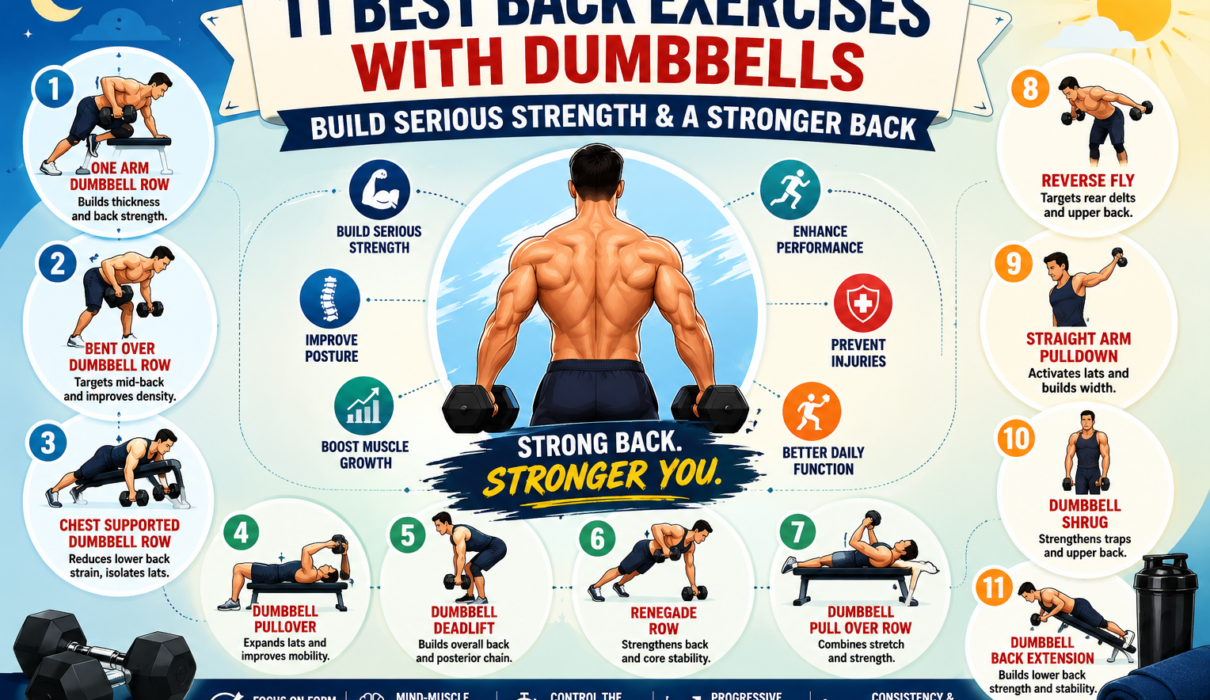
The 11 best back exercises with dumbbells
1. Dumbbell deadlift
Why it belongs: The king of foundational back exercises. The dumbbell deadlift teaches your entire posterior chain to work as a unit while grooving the hip hinge pattern every other exercise on this list depends on.
Primary muscles: Erector spinae, glutes, hamstrings, traps
Common mistake: Rounding the lower back at the bottom. Keep your chest proud and core braced throughout the movement.
Pro Tip: Squeeze the dumbbells hard before you pull. This engages your lats and protects your shoulders automatically.
2. Single-arm dumbbell row
Why it belongs: One of the most effective upper back exercises ever created. The unilateral setup corrects muscle imbalances and allows a greater range of motion than barbell variations.
Primary muscles: Latissimus dorsi, rhomboids, rear deltoids, biceps
Common mistake: Rotating the torso excessively to lift heavier. The movement should come from your elbow driving back, not from a whole-body twist.
Pro Tip: Think of your hand as a hook. The arm is just the connector. Pull from your elbow, not your wrist.
3. Bent-over dumbbell row (bilateral)
Why it belongs: A cornerstone of any dumbbell back workout, the bilateral bent-over row loads both sides equally and builds serious thickness across the entire mid-back.
Primary muscles: Rhomboids, mid-traps, lats, rear deltoids
Common mistake: Standing too upright. Hinge your torso to about 45 degrees so the dumbbells travel in a straight vertical line and your back does the work.
Pro Tip: Pause one full second at the top of each rep. This eliminates momentum and maximizes muscle engagement.
4. Chest-supported dumbbell row
Why it belongs: Removing the stability demand means your back muscles cannot cheat. This exercise isolates the mid-back beautifully and is perfect for anyone who tends to use their lower back as a crutch.
Primary muscles: Rhomboids, middle traps, rear deltoids
Common mistake: Letting the shoulder blades flare outward at the bottom. Lower with control and let the scapulae spread fully.
Pro Tip: Set an incline bench between 30 and 45 degrees. Higher angles shift focus toward the upper traps.
5. Dumbbell pullover
Why it belongs: A unique exercise that stretches the lats through a long range of motion — something most row variations cannot achieve. The pullover complements rows perfectly and builds lat depth that transforms the back silhouette.
Primary muscles: Lats, teres major, long head of triceps, serratus anterior
Common mistake: Bending the arms excessively. Keep a soft elbow and focus on feeling a deep lat stretch at the top of each rep.
Pro Tip: Perform this immediately after rows while your lats are pumped. The stretch-under-load combination accelerates muscle growth.
6. Dumbbell shrug
Why it belongs: Your traps are part of your back. Neglecting them leaves the upper back underdeveloped and the neck and shoulder junction vulnerable to injury. Weighted shrugs target the upper trapezius directly.
Primary muscles: Upper trapezius, levator scapulae
Common mistake: Rolling the shoulders in a circular motion. Lift straight up and straight down. There is no rotation in a correct shrug.
Pro Tip: Hold the shrug for two seconds at the top. Most people rush through this and get almost no benefit.
7. Renegade row
Why it belongs: This is where the Back Strength Pyramid shifts from development to performance. The renegade row combines anti-rotation core stability with unilateral pulling strength — making it as athletic as it is effective.
Primary muscles: Lats, rhomboids, core, obliques, shoulders
Common mistake: Allowing the hips to rotate or drop. Set a rigid plank position before each pull and maintain it throughout.
Pro Tip: Use lighter dumbbells than you think you need. The challenge here is stability, not raw load.
8. Dumbbell Romanian deadlift
Why it belongs: Unlike the conventional deadlift, the Romanian variation keeps tension on the hamstrings and lower back throughout the entire range of motion. This is essential for lower back strength and posterior chain development.
Primary muscles: Erector spinae, hamstrings, glutes, upper back
Common mistake: Bending the knees too much, turning it into a squat. Keep a soft knee throughout and hinge from the hips.
Pro Tip: Film yourself from the side at least once. Most people think they are hinging correctly until they see the footage.
9. Prone dumbbell Y-T-W raise
Why it belongs: Most back workouts ignore the smaller stabilizing muscles of the upper back and scapular region. This exercise corrects that gap and directly improves posture, shoulder health, and overhead strength.
Primary muscles: Lower traps, rhomboids, infraspinatus, teres minor
Common mistake: Using momentum or heavy dumbbells. This exercise should be done with very light weights and strict, slow control.
Pro Tip: Start with no weight at all. Master the positions first. Add minimal load only once form is flawless.
10. Dumbbell farmer’s carry
Why it belongs: Functional back strength is not just about pulling. Carrying heavy loads builds grip strength, scapular stability, and postural endurance that carries directly into daily life and athletic performance.
Primary muscles: Traps, erector spinae, core, forearms, glutes
Common mistake: Letting the shoulders elevate or round forward. Keep them packed down and back for the entire carry.
Pro Tip: Walk slower than you think you need to. Rushing reduces the postural challenge and time under tension.
11. Dumbbell high pull
Why it belongs: The dumbbell high pull sits at the very peak of the Back Strength Pyramid — a powerful, explosive movement that trains the upper back, traps, and posterior chain as an integrated system under speed and force.
Primary muscles: Traps, rear deltoids, rhomboids, erector spinae, glutes
Common mistake: Pulling with the arms instead of driving through the hips. The hip extension generates the power. The arms simply guide the dumbbells upward.
Pro Tip: Master the Romanian deadlift and bent-over row first. This exercise rewards those who have built a solid foundation.
Common mistakes that limit back growth
Even people following the best back exercises with dumbbells can stall if they repeat these errors week after week.
Lifting too heavy too soon
When the weight is too high, the arms, hips, and lower back compensate. The target muscles barely work. Ego-free training produces faster results than maxing out with poor mechanics.
Rushing every repetition
A two-second pull and a half-second return leaves very little time under tension — the primary driver of muscle growth. Slowing your reps will feel humbling at first, but the results speak for themselves.
Using your arms, not your back
Your hands are hooks. They hold the weight. Your elbows and shoulder blades do the actual pulling work. If your biceps are always sore after back day, your back is not pulling its weight — literally.
Neglecting postural foundations
All the rows in the world will not fix a back that lacks scapular awareness. Include exercises like the Y-T-W raise and farmer’s carry to build the stabilizing muscles that make every other exercise work better.
No progressive overload
Doing the same weight for the same reps every session is the definition of spinning your wheels. Track your workouts. Add a rep, add a kilo, or slow the tempo every single week.
How to get better results from every dumbbell back workout
Frequently asked questions
What are the best back exercises with dumbbells for beginners?
Start with the dumbbell deadlift, single-arm row, and chest-supported row. These three exercises build foundational movement quality while protecting the spine and shoulder joints from unnecessary strain. Master them before progressing.
How often should I do a dumbbell back workout?
Train your back two times per week with at least 48 hours of rest between sessions. Beginners can start with one dedicated back workout per week while still including back work in full-body sessions.
Can I build a strong back with only dumbbells?
Absolutely. Dumbbells allow a full range of motion, correct muscular imbalances, and can match the loading demands of any barbell exercise. Many athletes have built world-class backs using only dumbbell strength training.
How long does it take to see results from a back workout with dumbbells?
Most people notice improved posture and functional strength within four to six weeks of consistent dumbbell back training. Visible muscle development typically requires eight to twelve weeks of progressive effort combined with sufficient nutrition.
Do dumbbell back exercises help improve posture?
Yes — significantly. Exercises like the chest-supported row, single-arm row, and Y-T-W raise directly strengthen the muscles responsible for scapular retraction and spinal extension, which are the exact muscles that deteriorate from prolonged sitting and screen time.
Continue exploring on the blog
Ready to take your training further? These articles pair perfectly with your new back routine:
→ Upper body strength training workout
→ Bodyweight workouts for strength at home
→ Kettlebell strength training guide
Continue exploring on the blog
Ready to take your training further? These articles pair perfectly with your new back routine:
→ Upper body strength training workout
→ Bodyweight workouts for strength at home
→ Kettlebell strength training guide
→ Cardio exercise to reduce weight
