

 By
By Transform your fitness with these 9 best bodyweight workouts for full-body strength and muscle growth
The idea that building real strength and muscle requires a gym full of expensive equipment is one of the most persistent myths in fitness. The truth is that some of the most effective training methods require nothing more than a floor, a small amount of space, and a willingness to show up consistently. Bodyweight workouts have built athletic, lean, and powerful physiques for centuries, long before commercial gyms existed.
Interest in bodyweight training has grown significantly in recent years, driven by people who want results without the cost, commute, or time commitment of traditional gym training. The appeal is straightforward. “Bodyweight exercises are accessible anywhere, scalable to any fitness level, and for anyone still figuring out how to start working out at home without equipment, this guide is the most complete starting point available.”
At WayFitHub, this guide presents the nine best bodyweight exercises for full-body strength and muscle growth, a structured weekly workout plan, answers to the most common questions, and practical guidance for getting the most out of every session.
What You Will Learn in This Article:
- Why bodyweight training builds genuine strength and muscle
- Nine of the most effective bodyweight exercises with full guidance
- A beginner-to-intermediate weekly workout routine
- Whether bodyweight training can replace gym training
- Common mistakes that limit progress and how to correct them
- Practical beginner tips for faster and lasting results
A common misconception is that bodyweight training is only suitable for beginners or that it plateaus quickly. Neither is true. The body does not distinguish between a barbell and its own bodyweight as a source of resistance. What it responds to is mechanical tension, which is the force placed on muscle fibres during movement, and metabolic stress, which comes from sustained effort over time. Bodyweight exercises produce both.
The key advantages of bodyweight strength training go beyond convenience:
- Every bodyweight movement requires stabilising muscles to work alongside the primary movers, which builds functional, usable strength rather than isolated muscle.
- Exercises like push-ups, pull-ups, and squats train the body through natural movement patterns that carry over directly to athletic performance and daily physical demands.
- Core engagement is automatic in most bodyweight movements. Holding a plank, controlling a push-up, or stabilising through a lunge all require active core contraction throughout.
- Bodyweight training can be made progressively more challenging indefinitely by adjusting leverage, range of motion, tempo, or exercise variation, which keeps the stimulus for muscle growth consistent over time.
- Training anywhere without equipment removes the barriers of access, cost, and schedule that prevent many people from training consistently.

9 Best Bodyweight Workouts for Full-Body Strength and Muscle Growth
The following nine exercises cover every major muscle group and form the foundation of an effective bodyweight strength training program.
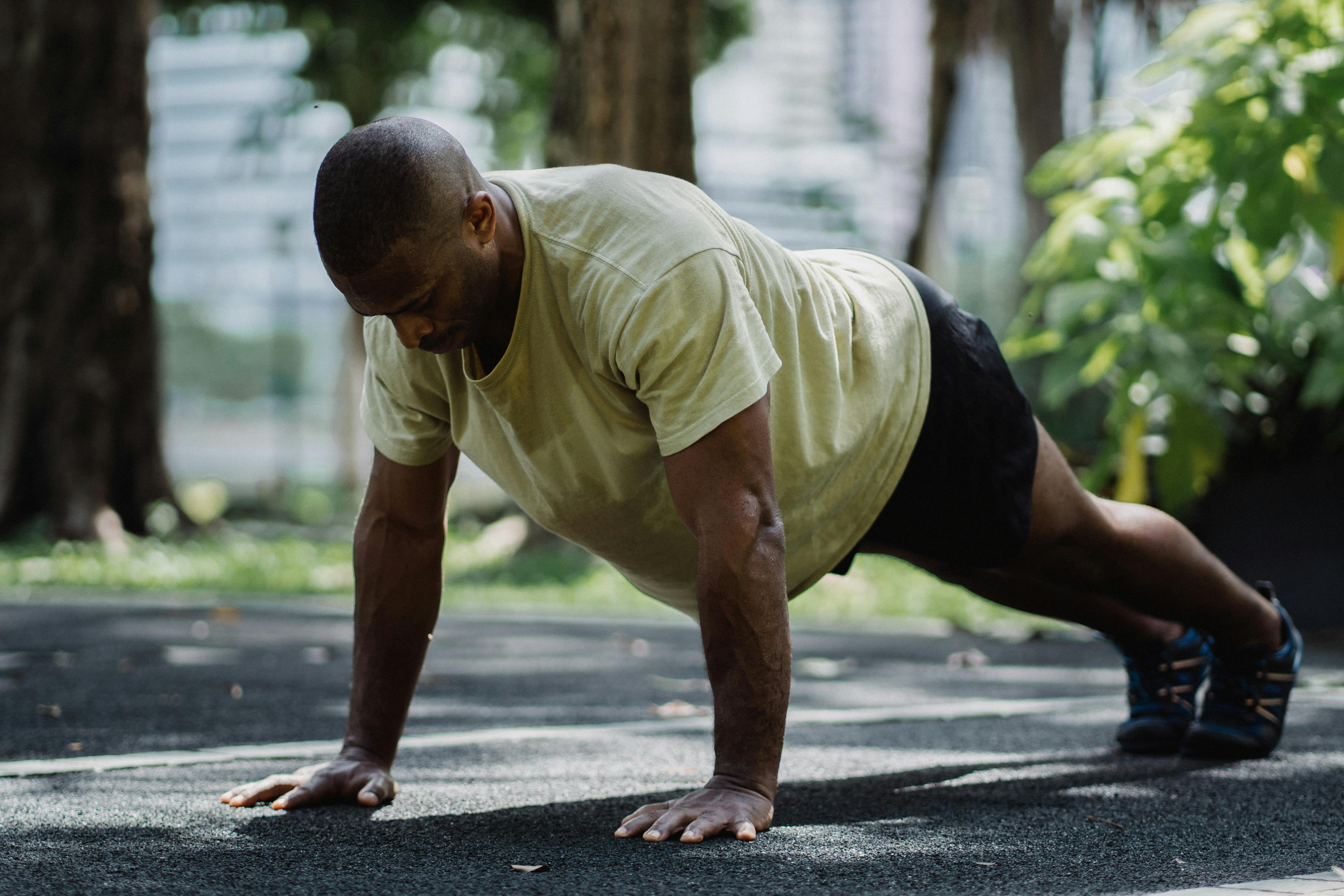
1. Push-Ups
Muscles targeted: Chest, front deltoids, triceps, core
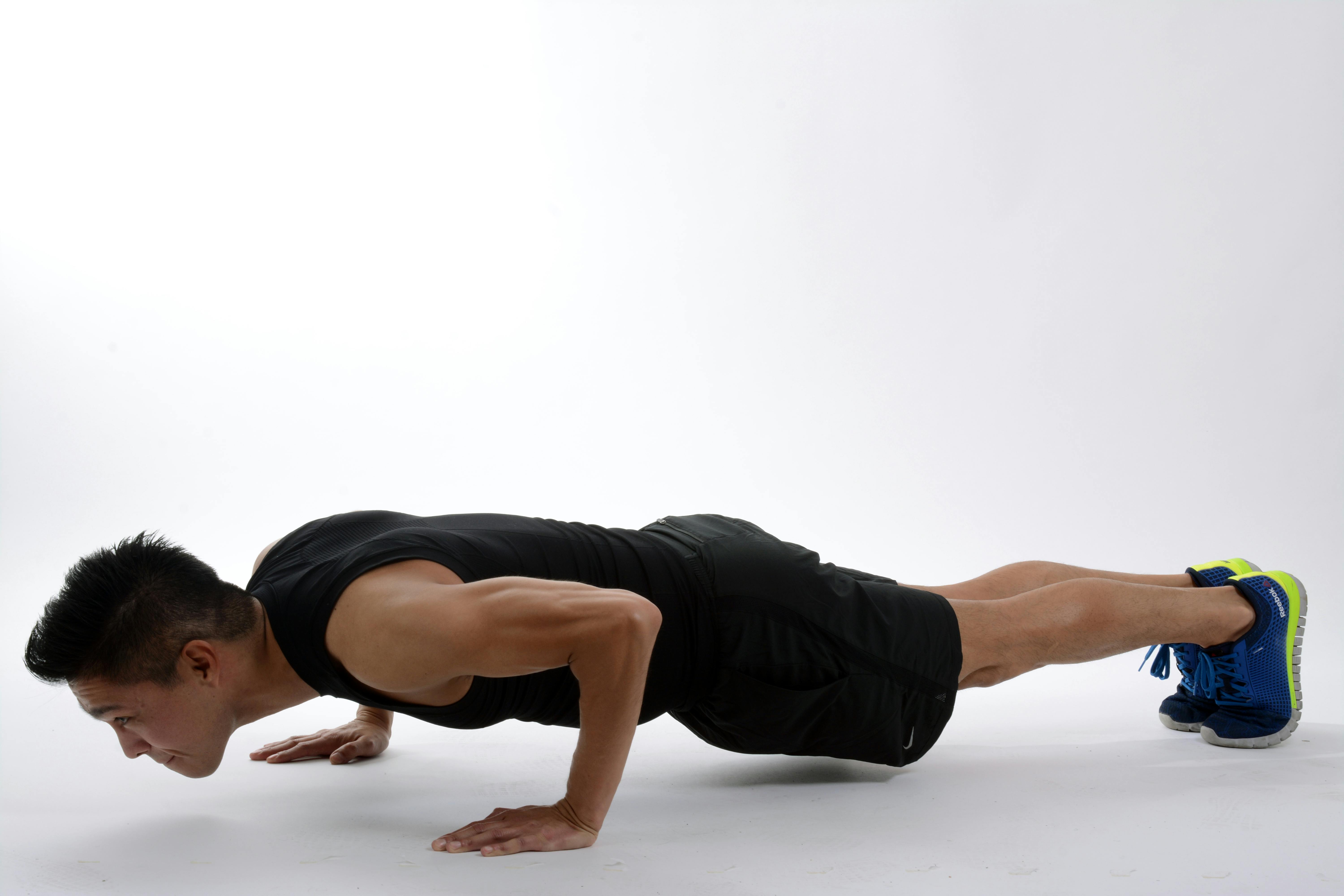
How it works: The push-up is the most fundamental upper body pressing movement. Start in a high plank position with hands slightly wider than shoulder-width. Lower the chest to the floor under control, keeping the elbows at roughly 45 degrees from the torso. Press back to the starting position with full arm extension at the top.
Beginner tip: If a full push-up is not yet achievable, begin with hands elevated on a bench or step. As strength builds, progressively lower the elevation until the floor-level push-up is accessible.
Common mistake: Allowing the hips to sag or pike upward, which removes tension from the chest and places unnecessary stress on the lower back. The body should form a straight line from head to heels throughout the movement.

2. Squats
Muscles targeted: Quadriceps, glutes, hamstrings, inner thighs, core
How it works: Stand with feet shoulder-width apart and toes turned slightly outward. Lower by pushing the hips back and bending the knees simultaneously, keeping the chest upright and heels flat on the floor. Descend until the thighs are at least parallel to the floor, then drive through the heels to stand.
Beginner tip: Holding both arms straight out in front provides counterbalance and makes it easier to maintain an upright torso during the descent. Use this as a starting point before progressing to more demanding squat variations.
Common mistake: Letting the heels rise off the floor or the knees cave inward on the way up. Both indicate tight ankles or weak glutes and should be addressed before increasing volume.

3. Pull-Ups
Muscles targeted: Latissimus dorsi, biceps, rear deltoids, core
How it works: Hang from a bar with an overhand grip slightly wider than shoulder-width. Drive the elbows down toward the hips to pull the chest toward the bar. Lower with control until the arms are fully extended before pulling again.
Beginner tip: If pull-ups are not yet possible, use a resistance band looped over the bar for assistance, or begin with inverted rows using a low bar. Building grip strength and lat engagement with these regressions makes the transition to unassisted pull-ups significantly easier.
Common mistake: Using momentum to swing the body upward rather than pulling with the back muscles. This reduces effectiveness and increases shoulder strain. Every rep should be controlled from start to finish.

4. Lunges
Muscles targeted: Quadriceps, glutes, hamstrings, hip stabilisers
How it works: Step forward with one foot and lower the back knee toward the floor without letting it touch. Keep the front shin as vertical as possible and the torso upright throughout. Drive through the front heel to return to standing, then alternate legs.
Beginner tip: Begin with stationary lunges before progressing to walking lunges. Stationary lunges allow full focus on balance and depth without the added coordination demand of forward travel.
Common mistake: Taking a step that is too short, which pushes the front knee excessively forward over the toe. A longer stride keeps the load distributed more evenly across the glute and thigh.

5. Plank Hold
Muscles targeted: Core, shoulders, glutes, lower back
How it works: Place the forearms on the floor with elbows directly beneath the shoulders. Extend the legs behind and hold the body in a straight line from head to heels. Squeeze the glutes and brace the core actively throughout the hold rather than passively resting in position.
Beginner tip: Start with holds of 20 to 30 seconds and focus entirely on maintaining the straight body position. Duration means nothing if the hips are sagging. A 20-second plank with perfect form produces more benefit than a 60-second plank with a collapsed midsection. For a dedicated approach to building core strength alongside this program, the complete guide to core workouts for beginners covers every foundational exercise in detail.”p
Common mistake: Allowing the hips to drop toward the floor or rise toward the ceiling. Both positions remove the core engagement that makes the plank effective.
6. Burpees
Muscles targeted: Full body, cardiovascular system
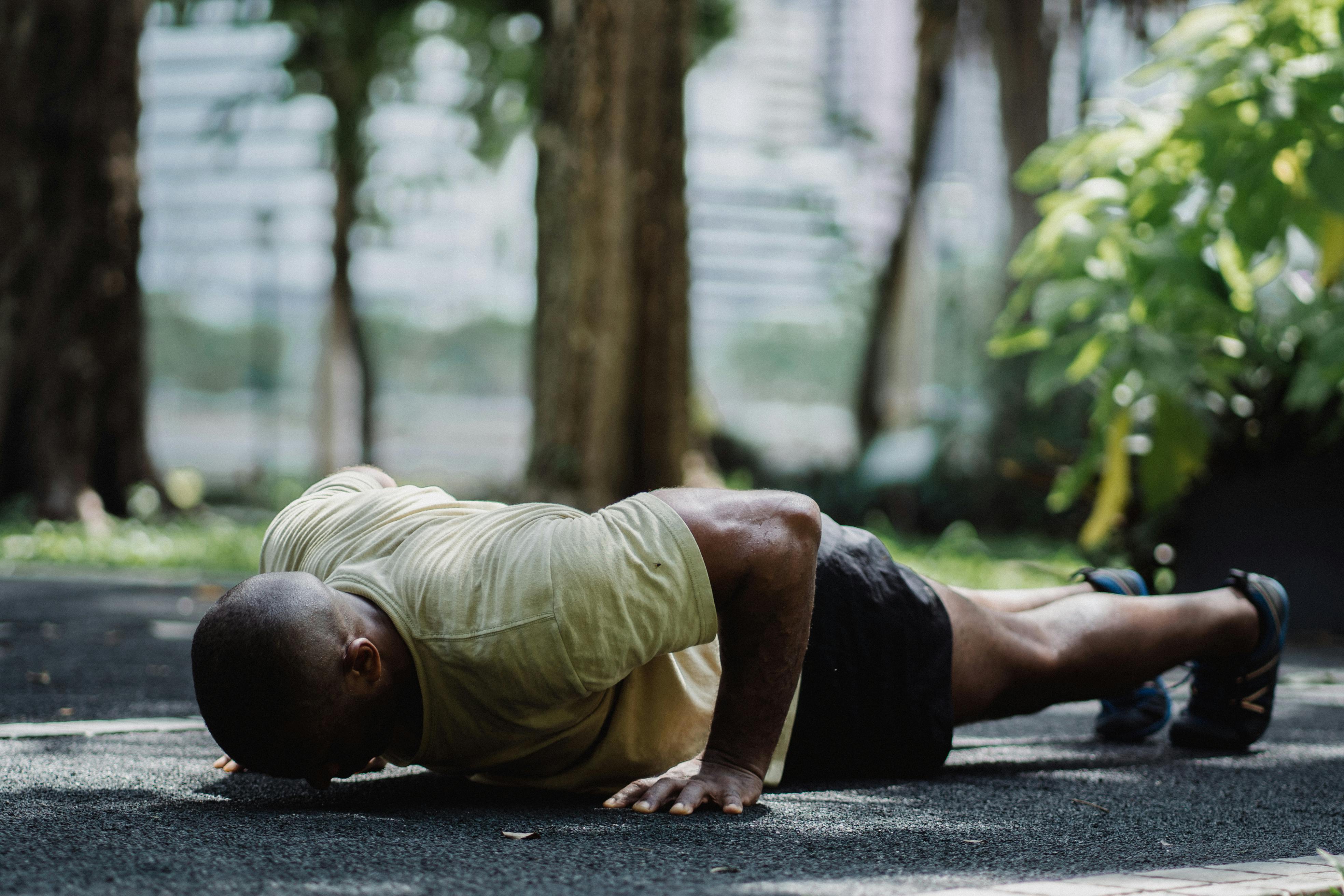
How it works: From standing, drop the hands to the floor and jump or step the feet back into a push-up position. Perform one push-up, then jump or step the feet back toward the hands. Drive through the legs to jump upward with the arms overhead. Land softly and repeat.
Beginner tip: Remove the jump at the top and replace it with a standing step if the impact is too demanding. The push-up can also be removed initially. Add each component back in progressively as conditioning improves.
Common mistake: Rushing through reps with poor form to hit a number faster. Each phase of the burpee should be deliberate. Sloppy burpees at high volume are one of the most common causes of wrist and lower back strain in bodyweight training.
7. Mountain Climbers
Muscles targeted: Core, hip flexors, shoulders, cardiovascular system
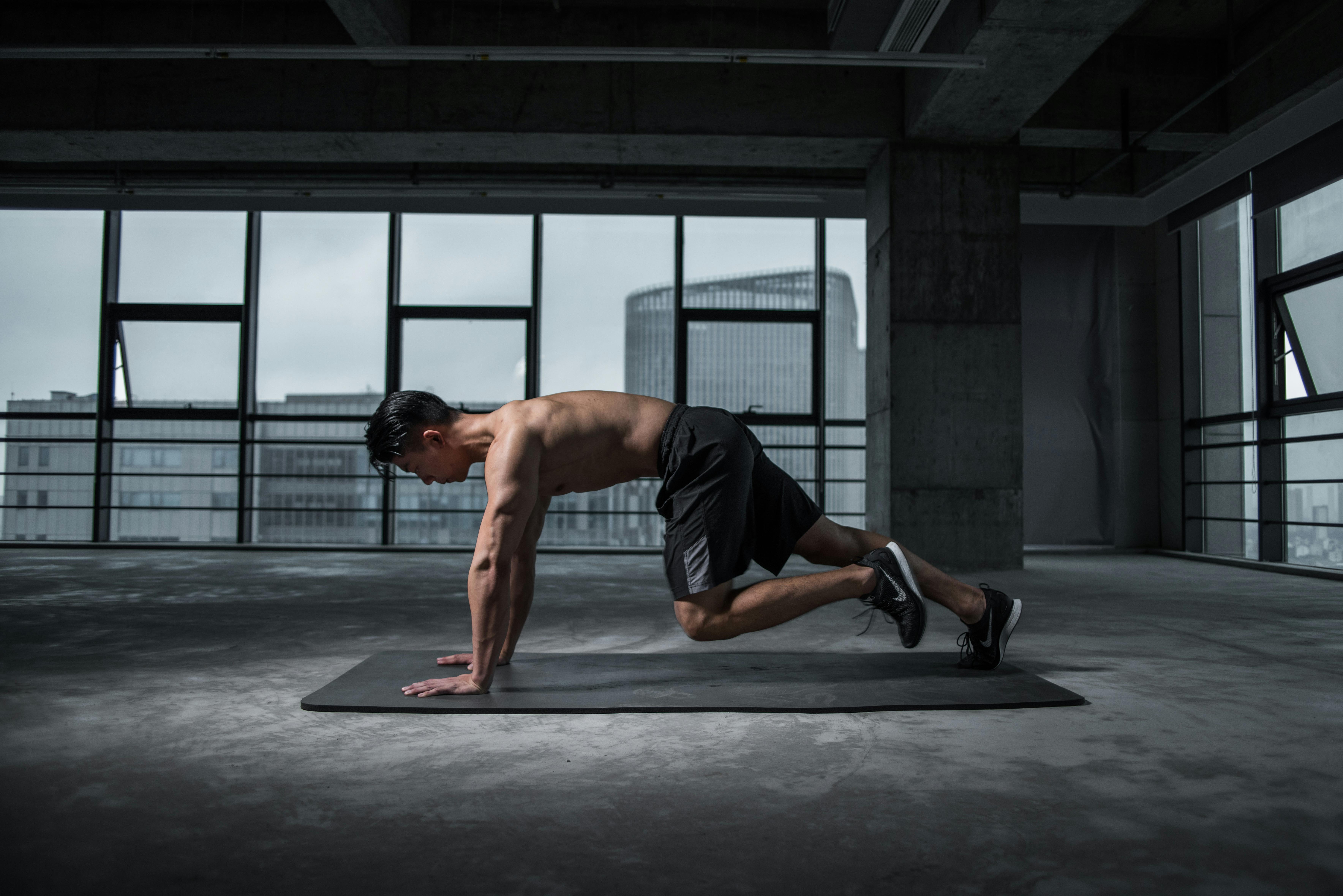
How it works: Begin in a high plank position with arms fully extended. Drive one knee toward the chest while keeping the hips level, then switch legs rapidly in a running motion. The hips should remain low and the shoulders should stay directly above the wrists throughout.
Beginner tip: Slow the pace significantly and focus on keeping the hips from rising with each knee drive. Speed can be added once the mechanics are stable and the core is holding its position correctly.
Common mistake: Allowing the hips to rise with each repetition, which turns the movement into a hip flexor drill rather than a core exercise. Keep the hips level and steady throughout.
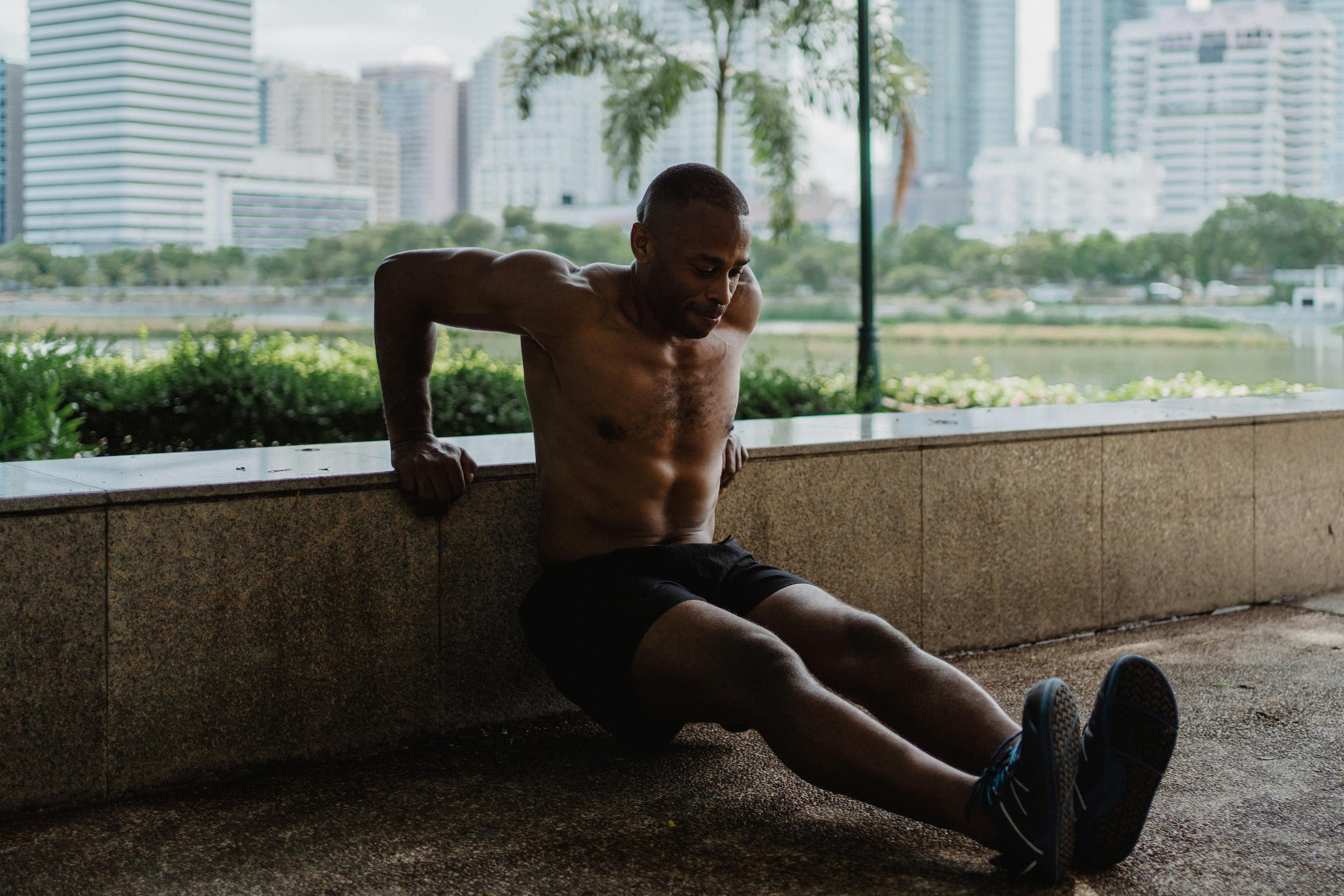
8. Dips
Muscles targeted: Triceps, lower chest, front deltoids
How it works: Position both hands on a stable surface such as parallel bars, the edge of a bench, or two sturdy chairs. With straight arms supporting the body, bend the elbows to lower until the upper arms are roughly parallel to the floor. Press back to straight arms.
Beginner tip: Bench dips with bent knees reduce the load and serve as an accessible starting point. As strength builds, extend the legs and eventually progress to bar dips with the full bodyweight suspended.
Common mistake: Leaning too far forward, which shifts the emphasis away from the triceps and onto the chest and shoulders. For tricep-focused dips, keep the torso as upright as possible throughout.
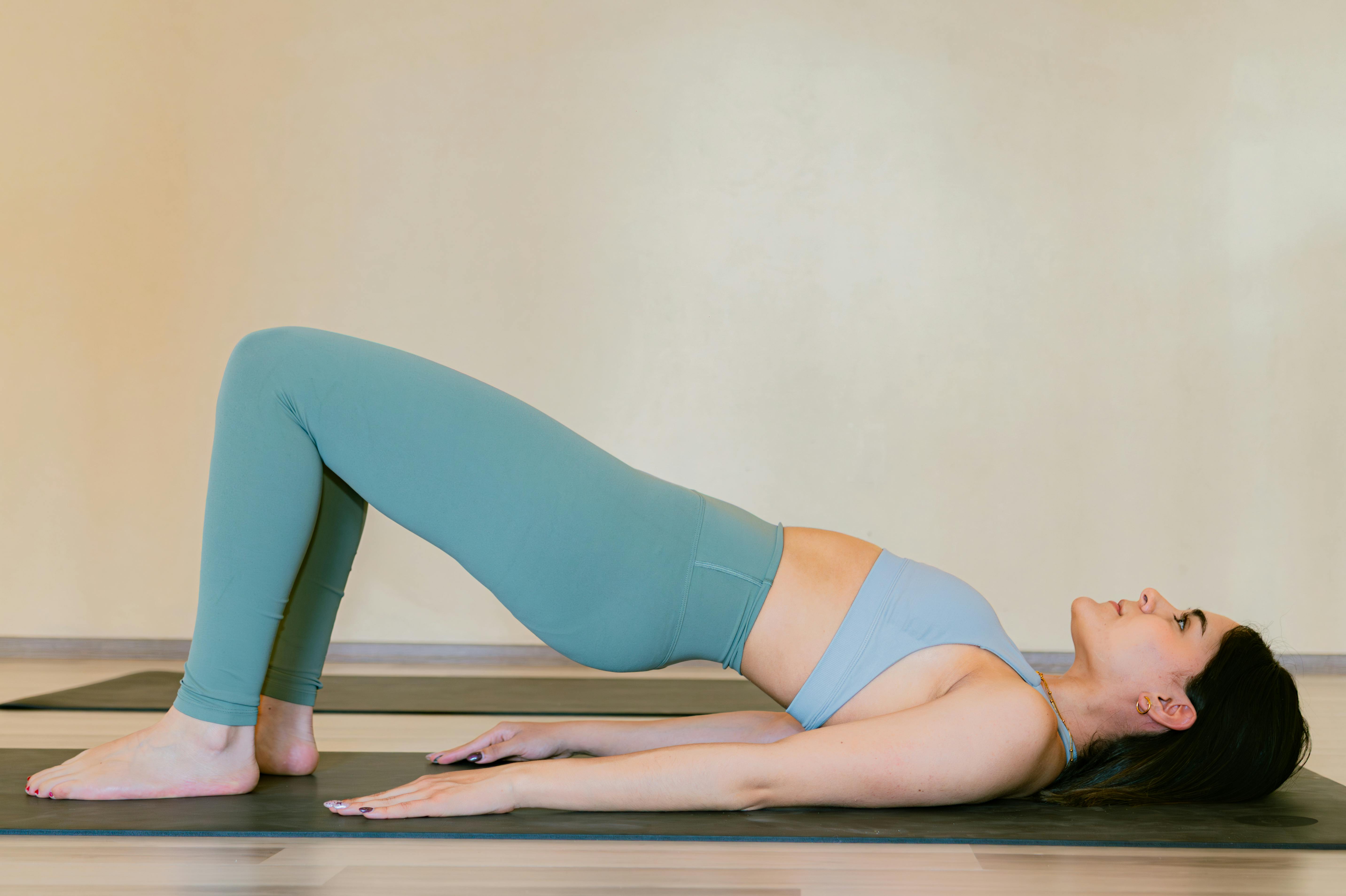
9. Glute Bridges
Muscles targeted: Glutes, hamstrings, lower back, hip stabilisers
How it works: Lie on the back with knees bent and feet flat on the floor, hip-width apart. Drive through the heels to lift the hips until the body forms a straight line from knees to shoulders. Squeeze the glutes firmly at the top and hold for one to two seconds before lowering with control.
Beginner tip: Focus on pressing through the heels rather than the toes. Heel-driven pressure activates the glutes far more effectively. If the hamstrings cramp, move the feet slightly further from the body.
| Full-Body Bodyweight Workout Routine
This plan runs three days per week with at least one rest day between each session. All nine exercises are incorporated across the week with enough volume to stimulate muscle growth and sufficient recovery to support adaptation.
Training frequency: 3 days per week. Recommended schedule: Monday, Wednesday, Friday.
| Exercise | Sets | Reps / Hold | Rest |
| Push-Ups | 3 | 12 to 15 | 60 sec |
| Squats | 3 | 15 to 20 | 60 sec |
| Glute Bridges | 3 | 15 | 45 sec |
| Lunges | 3 | 10 each leg | 60 sec |
| Plank Hold | 3 | 30 to 45 sec | 45 sec |
| Pull-Ups | 3 | Max controlled reps | 90 sec |
| Dips | 3 | 10 to 12 | 75 sec |
| Mountain Climbers | 3 | 20 each leg | 45 sec |
| Burpees | 2 | 8 to 10 | 90 sec |
Progressive overload: Every two weeks, increase the difficulty by adding reps, reducing rest periods, or progressing to a harder exercise variation. Push-ups can progress to close-grip or archer push-ups. Squats can progress to single-leg variations. Pull-ups can move from assisted to unassisted to weighted. Consistent progression is what separates continued improvement from stagnation.
Warm-up: Begin every session with five to eight minutes of dynamic movement. Arm circles, leg swings, hip rotations, and bodyweight squats at a slow pace are all effective. Cold muscles and connective tissue are significantly more prone to strain during the explosive demands of burpees, pull-ups, and dips.
| Can Bodyweight Workouts Really Build Muscle?
This question comes up consistently, and the answer is yes, provided the training is structured around the same principles that govern muscle growth in any form of resistance training.
Muscle growth requires three things: sufficient mechanical tension placed on the muscle fibres, enough metabolic stress to signal adaptation, and adequate recovery to allow that adaptation to occur. Bodyweight exercises deliver all three when programmed with appropriate volume, progressive difficulty, and consistent rest.
The most important principle is progressive overload. Performing the same exercises at the same difficulty level indefinitely produces initial results followed by a plateau. The training stimulus must continue to increase over time. With bodyweight training, this is achieved through exercise progressions, added volume, reduced rest, slower tempos, or single-limb variations rather than simply adding weight to a bar.
Realistic expectations are important. Muscle growth through bodyweight training follows the same timeline as gym-based training. Noticeable strength improvements typically appear within three to four weeks. Visible changes in muscle tone and definition develop over two to four months of consistent training supported by appropriate nutrition. People who train with patience and structure consistently achieve results that match or exceed those from conventional gym programs. Those who want to accelerate that progression further by adding equipment can find a complete approach in the kettlebell strength training guide, which builds directly on the strength base developed here.”
| Common Bodyweight Training Mistakes
Training with poor form: Every exercise in this guide has a specific mechanics requirement. Deviating from proper form reduces the effectiveness of each movement and increases the risk of overuse injuries, particularly at the wrists, shoulders, and knees. Form should always take priority over rep count.
Skipping the warm-up: Beginning intense bodyweight work without preparing the joints and muscles first is one of the most direct routes to unnecessary injury. Five minutes of light dynamic movement before every session is a non-negotiable part of effective training.
Training without progression: Performing the same exercises at the same difficulty for weeks without change produces stagnation. The body adapts quickly. Progression must be intentional and regular to maintain the stimulus that drives continued strength and muscle development.
Inconsistent training schedule: Sporadic sessions separated by long gaps prevent the accumulation of training stimulus that drives adaptation. Three consistent sessions per week over eight to twelve weeks will always produce better results than irregular high-effort days followed by extended inactivity.
Neglecting recovery and nutrition: Muscle is built during rest, not during training. Insufficient sleep, inadequate protein intake, and chronic under-eating all limit what the body can produce regardless of how hard the sessions are. Recovery must be treated as seriously as the training itself.
| Beginner Tips for Better Results
Prioritise form before volume: Perfect the mechanics of every exercise before increasing reps or difficulty. Correct movement patterns built early become automatic and produce better results over the long term than compensated reps at higher volume.
Train on a fixed schedule: Assign specific training days at the start of each week and commit to them. Flexibility in scheduling tends to produce consistently skipped sessions. Fixed days remove the daily decision of whether to train.
Track every session: Record the exercises completed, reps achieved, and how each session felt. Tracking makes progressive overload intentional and provides a motivating record of improvement over weeks and months.
Increase difficulty gradually: Jumping too quickly to advanced variations before mastering the fundamentals is one of the most common causes of stalled progress. Build the base movement pattern first and earn each progression.
Support training with nutrition: Protein intake supports muscle repair and growth. Including a quality protein source in every meal, staying hydrated, and eating enough total calories to support training demands amplifies the results from every session.
Prioritise sleep: Seven to nine hours of quality sleep per night is the most effective recovery tool available. Strength, focus, and muscle repair all depend on it. Treating sleep as a training variable rather than an afterthought accelerates results noticeably.
| Final Thoughts
Bodyweight workouts remove every barrier that typically prevents people from training consistently. There is no equipment to buy, no gym to travel to, and no schedule to work around. The only requirement is commitment to showing up and progressing with intention.
The nine exercises in this guide are not simple or easy. Push-ups, pull-ups, burpees, and Bulgarian split squats challenge the body meaningfully at every level. What makes them accessible is that every one of them can be scaled to meet any starting point and made progressively harder to meet any goal.
At WayFitHub, the approach has always been to deliver practical guidance that produces real results for real people. Bodyweight strength training fits that standard precisely. The method works. The exercises are proven. The progression is clear. For women over 40 beginning or returning to training, the guide on strength training for women over 40 provides additional guidance tailored to that specific starting point.”
Follow the plan, increase the challenge over time, support training with proper nutrition and sleep, and the results will come consistently.
