

 By
By Muscle loss after 40: 9 warning signs and proven ways to reverse it
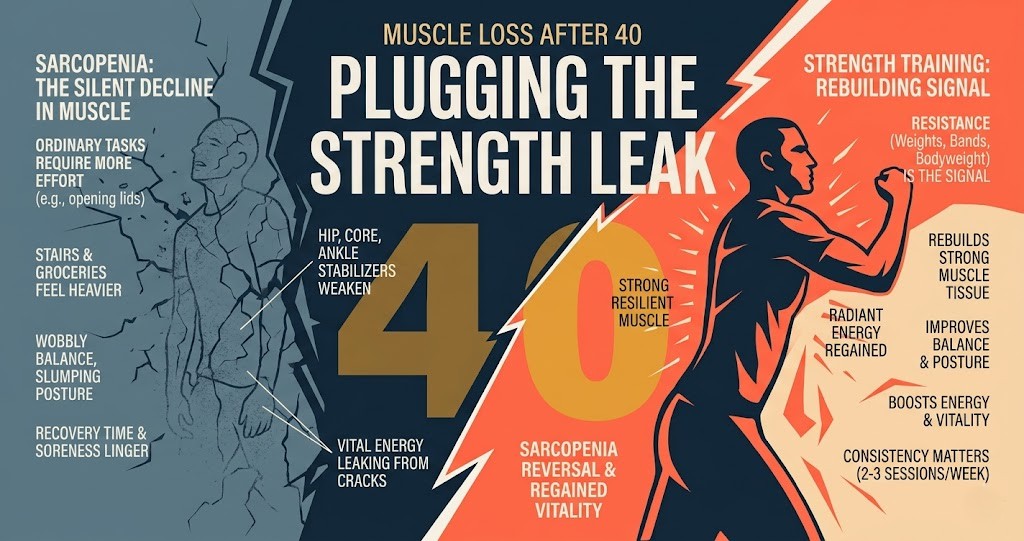
There was a jar of pickles on the counter last week that simply would not open. Same hands that used to twist off any lid without thinking. A small thing, easy to laugh off, except it was not the first small thing this month. The stairs at work have started to feel taller. A grocery bag that used to be nothing now earns a quiet pause halfway to the car.

Most people file moments like this under being tired, being busy, or just getting older. But there is something more specific happening underneath, and it has very little to do with age itself and everything to do with muscle.
The strength leak nobody talks about
Picture a slow leak in a tire. Nothing dramatic happens overnight, the tire still looks fine, the car still drives, but every week it sits a little lower. Muscle loss works almost exactly like this. It does not announce itself with a single dramatic event. It drains quietly, task by task, until one day the jar will not open and you are left wondering why.
This is what makes muscle loss symptoms so easy to miss. They do not feel like an illness. They feel like a string of unrelated annoyances, and that is precisely the trap.
The everyday tasks that quietly get harder
Watch for the moments where something physical that used to take zero thought suddenly takes effort. Carrying both bags of groceries in one trip instead of two. Standing up from a low couch without using your hands. Opening jars, twisting caps, gripping a heavy pan by the handle. These are not random inconveniences, they are early muscle loss symptoms showing up in the exact places your body relies on grip and leg strength the most.
Balance, posture, and the moments that catch you off guard
A second cluster shows up in balance. A slight wobble stepping off a curb. Feeling less steady on uneven ground than you remember being. Posture that slumps by the end of the day without you noticing it happening. These are signs of muscle loss working through the stabilizing muscles around your hips, core, and ankles, the ones that quietly keep you upright without ever asking for credit.

Recovery that takes longer than it used to
The third cluster is about bouncing back. A short walk that leaves your legs more tired than it should. Soreness from ordinary activity that lingers two or three days instead of one. Feeling wiped out after a flight of stairs that used to be nothing. This is muscle deterioration showing up not as weakness in the moment, but as a slower, heavier recovery afterward.
Changes you can see in the mirror
The last cluster is visual. Arms or thighs that look a little softer or smaller even though the scale has not moved much. Clothes fitting differently around the shoulders or legs while the waistband stays roughly the same. This is often the most confusing sign because weight loss and muscle loss can happen at completely different speeds, which means the mirror can lie to you for months before the number on the scale ever catches up.
The hidden clock behind muscle deterioration
There is a formal clinical name for this structural shift: sarcopenia. While it sounds intimidating, it is simply the medical term for the age-related decline of muscle mass and function.
The truly surprising fact about this process is how early the clock starts ticking. Research shows that muscle deterioration can begin as early as your third decade, with most people losing roughly three to five percent of their muscle mass every decade after turning 30. If you have spent the last ten or fifteen years working a desk job and focusing primarily on cardio or diet, a significant portion of that baseline strength may have already leaked away without your knowledge.
Reversing the leak through mechanical signaling
The good news is that your body is remarkably responsive, and this process is entirely reversible. You do not need a medical muscle wasting treatment; you simply need to change the cellular instructions you send to your body. Strength training works because it creates a controlled form of mechanical stress on your frame. When you challenge your body with resistance, or your own bodyweight, you create microscopic demands that tell your nervous system that the current supply of muscle is insufficient for your environment.
In response to this stimulus, your body kicks into repair mode, pulling in amino acids to rebuild and reinforce the tissue. This mechanical signaling is the only natural mechanism that stops the strength leak in its tracks. Walking and jogging are fantastic for your heart and lungs, but they do not provide the specific, high-threshold stimulus required to trigger new muscle growth. By introducing regular resistance work, you force your body to prioritize muscle retention and synthesis, effectively turning back the physiological clock.

Reclaim your physical foundation
You do not have to accept a slow decline in your physical capability as an unchangeable fact of life. The changes you are feeling are completely real, but they are also completely manageable. True independence begins with the quiet certainty that your body can easily handle whatever your day demands of it, from lifting heavy luggage to maintaining perfect balance on an uneven path.
The single best action you can take today is to commit to a simple, consistent resistance routine. Whether you choose to use your own body weight, resistance bands, or a pair of dumbbells, the key is to start moving against friction a few times each week. You have the ability to patch the strength leak, rebuild your physical foundation, and move through the world with absolute confidence again.
To help you get started safely and effectively from the comfort of home, check out our comprehensive guide on WayFitHub for more ways to build strength at any age and find the routine that fits your life, right from home.
