

 By
By Strength training for toned body: what actually builds lean muscle
You have been showing up. Session after session, you have lifted, sweat, and pushed through sets that left your arms shaking. Yet when you look in the mirror, the shape you were hoping for still feels out of reach, and somewhere in the back of your mind sits a quiet fear that maybe you are getting bigger instead of leaner.
Maybe you have started skipping certain lifts because a friend once said they would make you bulky. Maybe you have swapped weights for endless cardio, hoping that would finally reveal the lean look you are after, only to end up tired, a little smaller, but not really more defined. If any of that sounds familiar, you are not doing anything wrong as a person. You have simply been working with the wrong information.
That fear is more common than most trainers admit, and it is rarely about your effort. It is about a mismatch between what your body is trained to do and what it is actually being told to do. Strength training for toned body does work, but only when the training itself is built around the right kind of signal, not just the right kind of exercise.

Why lifting weights does not automatically mean getting bulky
Somewhere along the way, strength training picked up a reputation it does not fully deserve. The image of dramatic size gain gets attached to any mention of lifting, even though visible bulk requires a very specific combination of genetics, hormonal environment, calorie surplus, and years of targeted overload. Most people training for tone are nowhere near that combination, whether they realize it or not.
The confusion usually comes from watching people who train for a completely different goal, often for years, with a completely different eating pattern behind the scenes. Borrowing a fear from that world and applying it to a regular training session is a bit like avoiding the kitchen because a professional chef sometimes burns themselves, the risk that applies to one context rarely transfers cleanly to another.
What actually happens instead is simpler and far less dramatic. When you lift with intention, muscle fibres tighten, fill in loose or soft areas, and create the kind of visible definition people usually describe as toned. The size increase involved is small and slow, while the shape change is what stands out first and fastest.
It helps to remember that the body you are training already has a shape underneath it, one that months of avoiding the weights rack have kept hidden rather than absent. Strength training does not invent a new physique out of nowhere. It brings the existing structure forward, tightening what was loose and giving edges to areas that used to look soft, which is a very different process from adding size on top of what is already there.
Strength training for toned body versus training built to bulk
Here is the part almost nobody explains clearly. Muscle does not know the difference between an exercise meant for size and an exercise meant for shape. It only responds to a signal, a specific pattern made up of how much tension it holds, how long that tension lasts, and how much time it gets to recover before the next round.
Think of two sculptors given the same block of clay. One presses down hard and holds, packing the material inward and building thickness. The other works in slower, controlled passes, refining the same block into a leaner, more defined form without adding much material at all. The clay is the muscle. The technique is the signal, and it decides which sculpture you end up with.
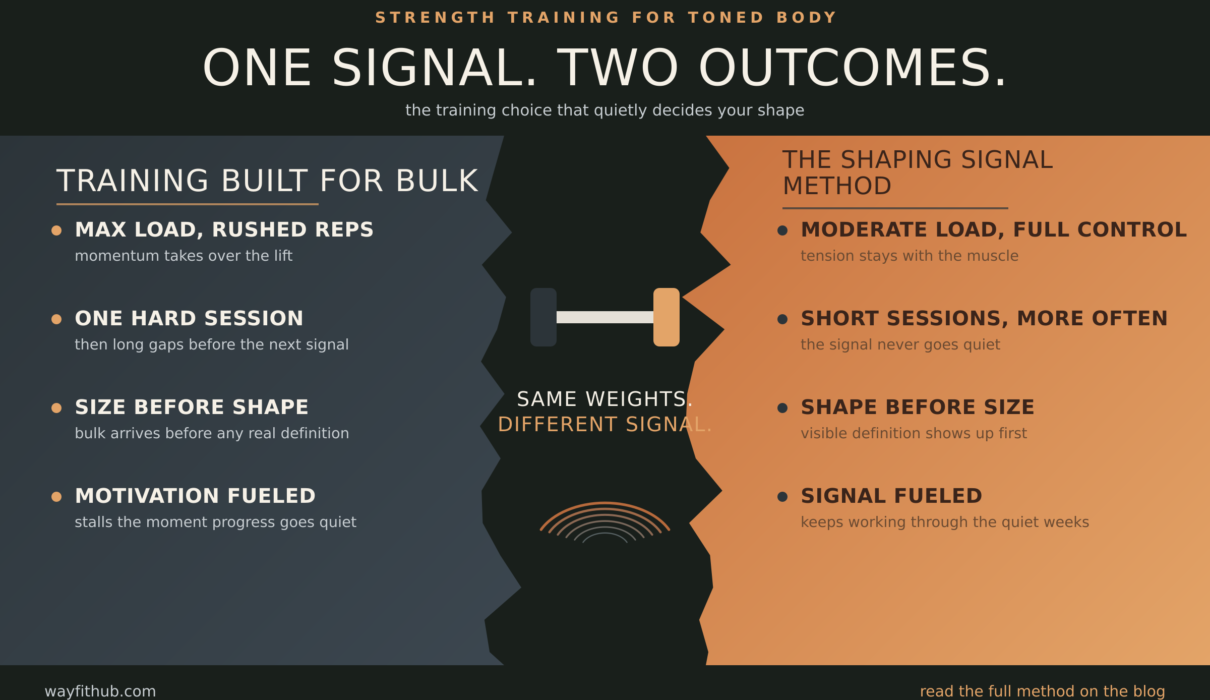
This is the shaping signal, and it depends on three things working together: moderate load instead of maximum load, slower tempo instead of rushed repetitions, and shorter, more frequent training touches instead of long, infrequent overload sessions. Change any one of these and the same lift starts sending a completely different message to the muscle underneath.
This is also why two people can follow what looks like the same workout plan and end up with completely different results. One person rushes through repetitions using momentum to move the weight, sending a signal built almost entirely for raw strength. The other slows down, controls the weight through its full range, and lets the muscle stay under tension a little longer, sending the exact signal that builds a leaner, more sculpted shape. Same exercise, same equipment, and a completely different outcome, because the signal was never really about the movement itself.

How to apply the shaping signal without overcomplicating your routine
You do not need a complicated program to use this. What you need is a small shift in how you approach the lifts you are probably already doing. Slow the lowering phase of each movement down until it takes real control to complete, since that lengthened tension is where shape gets built. Keep the weight moderate enough that the last two repetitions of a set feel demanding but not desperate.
Just as important, train the same muscle group more often at a lighter touch rather than rarely at full intensity. A shorter, more frequent signal keeps the shaping response active throughout the week instead of spiking it once and letting it fade. This single adjustment, sent consistently, is often the missing piece between people who lift for months and still feel stuck, and people who start noticing visible change within a few weeks. This is what makes strength training for toned body actually sustainable over the long run, not just for a few weeks of motivation.
A useful way to feel this in practice is to pay attention to where the effort actually lives during a set. If most of the strain shows up right at the end, in a rushed, jerky final push, the signal leans toward raw force rather than shape. If the strain builds evenly and stays present through a slow, controlled movement, that is the shaping signal doing its work. Once you can feel that difference, you no longer need to memorize a long list of rules, because your own body starts telling you when the signal is right.
The quiet habit that decides whether toning actually shows up
Even with the right signal, there is a habit that quietly determines whether any of this becomes visible. It is not motivation, and it is not willpower in the way most people picture it. It is the willingness to keep sending the same shaping signal on the weeks when nothing seems to be happening yet.
Muscle definition does not reveal itself in a straight line. It builds underneath the surface for a while before it becomes visible, and this gap is exactly where most people quit, right before the shape they were working toward was about to show up. The training was working. The patience simply ran out first.

Recognizing that gap for what it is changes the entire experience. Instead of wondering if the plan is failing, you start trusting that a controlled, well paced signal is doing its job quietly, the same way it has for anyone who has ever built a genuinely toned physique through training rather than shortcuts.
There is also a quieter benefit to understanding this gap ahead of time. Once you know that a lack of visible change in the early weeks is expected rather than a warning sign, you stop making impulsive changes to a plan that was actually working. People who understand the shaping signal tend to stay with one consistent approach for longer, and it is that stretch of uninterrupted consistency, more than any single workout, that eventually produces the toned look they were after all along.
Bringing it together
Strength training for toned body was never about lifting less or fearing the weights rack. It was about understanding what your muscle is actually listening to and giving it a signal built for shape instead of size. Moderate load, controlled tempo, and frequent, well spaced training sessions do more for definition than any amount of extra effort thrown at the wrong pattern.
None of this requires you to overhaul your entire routine overnight. Start by adjusting the pace of one lift you already do, notice how differently the muscle feels by the end of the set, and let that small shift build from there. The goal was never to lift less or lift harder for its own sake, it was to lift with a clearer sense of what you were actually asking your body to become.
The next time you walk into a session, you are not just doing another workout. You are sending a specific, deliberate signal that your body will respond to in exactly the way it was designed for. If this shift in thinking helped, there is more of this kind of training insight waiting across the rest of the blog, built the same way, one useful idea at a time.
