

 By
By
How to start working out at home without equipment: the ultimate beginner’s guide
By WayFitHub | Your Trusted Fitness Partner
Are you ready to transform your body but don’t have a gym membership? You don’t need one. Learning how to start working out at home without equipment is one of the most liberating fitness decisions you can make. Whether you’re a complete beginner or someone getting back on track, this guide covers everything you need to know to build a powerful, sustainable fitness routine right from your living room.
Why working out at home without equipment is the smartest move you can make
The fitness industry wants you to believe you need fancy machines, expensive memberships, and a personal trainer to get fit. The truth? Your body is the most powerful piece of equipment you’ll ever own. Working out at home without equipment gives you freedom, flexibility, and results — without spending a single rupee on a gym.
Here’s why millions of people are choosing to start working out at home without equipment:
- Zero cost: No gym fees, no commute, no locker room drama
- Total flexibility: Work out at 6 AM or midnight — you’re the boss
- Privacy: No judgment, no mirrors full of strangers, just you and your goals
- Consistency: When your gym is your bedroom, there’s no excuse to skip
The data backs this up too. Studies show that people who work out at home without equipment are more likely to maintain their routines long-term compared to gym-goers. Convenience is king when it comes to building habits.
Who is this guide for?
This guide is for anyone who wants to start working out at home without equipment — from a 20-year-old college student with a tiny dorm room to a 45-year-old parent with 30 minutes during naptime. You don’t need to be athletic. You don’t need to be young. You just need to be willing to begin.
At WayFitHub, we’ve helped thousands of people discover the power of bodyweight training. Our philosophy is simple: the best workout is the one you’ll actually do. And for most people, that means working out at home without equipment.
Understanding Bodyweight Training: The Science Behind No-Equipment Workouts
Before we dive into routines, let’s understand why working out at home without equipment actually works.
Progressive Overload Without Weights
Progressive overload is the principle of gradually increasing the challenge to your muscles over time. At the gym, you add weight to the bar. At home, you:
- Increase reps
- Slow down your tempo
- Add pauses at the hardest point of the movement
- Progress to harder exercise variations
This is how people working out at home without equipment build real, visible muscle and strength — the same physiological adaptation, just driven differently.
Muscle Activation Is About Tension, Not Tools
Your muscles don’t know the difference between a dumbbell and your own bodyweight. What they respond to is tension and time under tension. When you do a slow, controlled push-up, your chest, shoulders, and triceps experience the same mechanical stress as a barbell bench press. Working out at home without equipment is not a compromise — it’s a complete system.
Setting Up Your Home Workout Space
One of the first questions people ask when they want to start working out at home without equipment is: “Where do I even do this?”
You need surprisingly little space. A 6×6 foot area is enough for a full-body session. Here’s what to consider:
The Surface
A yoga mat or even a folded blanket works perfectly for floor exercises. For standing movements, any flat surface will do.
Ventilation
Make sure the room gets airflow. Good air circulation keeps your energy up during home workouts without equipment.
Distractions
Put your phone on Do Not Disturb. The biggest enemy of working out at home without equipment isn’t lack of space — it’s Netflix, notifications, and the fridge calling your name.
Lighting
Natural light is ideal, but any well-lit space works. You want to see your form clearly, especially when you’re learning new movements.
The Beginner’s Starter Kit: 10 Must-Know Bodyweight Exercises
These are the foundational movements of every effective home workout without equipment program. Master these, and you have everything you need.
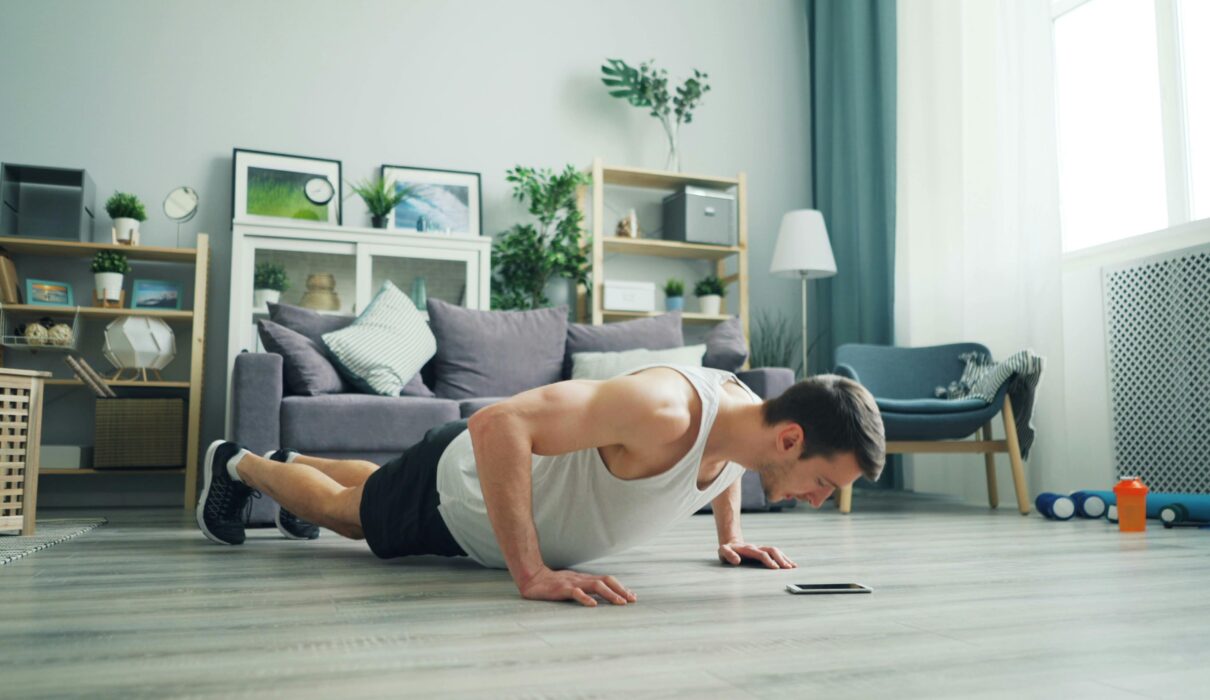
1. The Push-Up
The king of upper-body home exercises without equipment. Works chest, shoulders, triceps, and even your core.
How to do it: Start in a high plank with hands slightly wider than shoulders. Lower your chest to the ground, then push back up. Keep your body in a straight line throughout.
Beginner modification: Knee push-ups or wall push-ups. Advanced progression: Archer push-ups, diamond push-ups, decline push-ups.
2. The Squat
The foundation of lower-body strength in working out at home without equipment. Works quads, hamstrings, and glutes.
How to do it: Stand with feet shoulder-width apart, toes slightly out. Push your hips back and down like you’re sitting into a chair. Drive through your heels to stand back up.
Beginner modification: Sit-to-stand from a chair. Advanced progression: Jump squats, single-leg squats (pistol squats).
3. The Lunge
An essential movement pattern for anyone working out at home without equipment, the lunge trains each leg independently, correcting muscle imbalances.
How to do it: Step one foot forward and lower your back knee toward the ground. Push off the front foot to return. Alternate legs.
Variations: Reverse lunge, lateral lunge, walking lunge.
4. The Plank
The most underrated core exercise in no-equipment home workouts. The plank builds the deep stabilizing muscles that protect your spine.
How to do it: Hold a push-up position but rest on your forearms. Keep your hips level and your core braced. Hold for time.
Target: Start at 20–30 seconds, work up to 60 seconds.
5. The Glute Bridge
Perfect for activating the posterior chain — glutes, hamstrings, and lower back — without any equipment.
How to do it: Lie on your back, knees bent, feet flat. Drive your hips toward the ceiling, squeezing your glutes at the top. Lower slowly.
Progression: Single-leg glute bridge.
6. The Mountain Climber
A full-body burner that’s a staple in working out at home without equipment for both strength and cardio.
How to do it: Start in a high plank. Drive one knee toward your chest, then quickly switch legs. Maintain a flat back throughout.
7. The Burpee
Love it or hate it, the burpee is one of the most effective exercises in any home workout without equipment routine.
How to do it: Start standing. Drop your hands to the floor, jump your feet back to a plank, do a push-up, jump your feet forward, then jump up with arms overhead.
Modification: Remove the push-up and the jump for a low-impact version.
8. The Superman
Essential for posterior chain health, especially for those who spend long hours sitting and want to start working out at home without equipment.
How to do it: Lie face down, arms extended overhead. Simultaneously lift your arms, chest, and legs off the floor. Hold briefly, then lower.
9. The Tricep Dip (Chair Dip)
Using a chair or sofa, you can train your triceps effectively even with home workouts without equipment.
How to do it: Sit on the edge of a stable chair. Slide your hips off and lower your body by bending your elbows. Push back up.
10. High Knees
A powerful cardio movement for working out at home without equipment that also engages your hip flexors and core.
How to do it: Jog in place, driving your knees up toward your chest with each step. Pump your arms for intensity.
Your Complete 4-Week Beginner Home Workout Plan (No Equipment Needed)
This plan from WayFitHub is designed specifically for people who want to start working out at home without equipment but don’t know where to begin. It’s structured around three principles: progressive overload, adequate recovery, and variety.
Week 1: Build the Foundation (3 Days)
Day 1 – Full Body Introduction
- 10 push-ups (or knee push-ups)
- 15 squats
- 10 lunges each leg
- 20-second plank
- 15 glute bridges
- 10 mountain climbers each side
- Rest 60 seconds between exercises, repeat circuit 2 times
Day 2 – Active Rest Walk for 20–30 minutes. Light stretching. This is still part of working out at home without equipment — recovery is training.
Day 3 – Cardio Focus
- 30 seconds high knees
- 30 seconds rest
- 20 mountain climbers
- 30 seconds rest
- 10 burpees
- 30 seconds rest
- Repeat 3 rounds
Day 4 – Rest
Day 5 – Strength Focus
- 12 push-ups
- 20 squats
- 12 tricep dips
- 30-second plank
- 15 superman holds
- Repeat 2–3 rounds
Days 6 & 7 – Rest or light walking
Week 2: Build Momentum (4 Days)
Increase reps by 10–15% across all exercises. Add one extra set to each session. This is the core of progressive overload in home workouts without equipment.
Week 3: Introduce Harder Variations (4 Days)
Swap standard push-ups for close-grip push-ups. Add jump squats (2 rounds). Increase plank to 45 seconds. You’re now genuinely working out at home without equipment at an intermediate level.
Week 4: Test Your Progress (5 Days)
Max push-up test. Max squat test. Timed plank hold. Compare to your Week 1 numbers. The progress will shock you.
Nutrition Basics for Home Workouts: Fuel Without the Fuss
Working out at home without equipment will only get you so far if your nutrition is off. You don’t need a complex diet — just smart basics.
Protein
Aim for 0.8–1.2 grams of protein per kilogram of bodyweight. Great sources: eggs, paneer, dal, chickpeas, Greek yogurt, chicken, fish.
Carbohydrates
Don’t fear carbs. They’re your primary fuel for home workouts without equipment. Choose complex sources: brown rice, oats, sweet potato, whole wheat roti.
Hydration
Drink at least 2–3 liters of water daily. Dehydration tanks your performance, even in a short home workout without equipment.
Timing
Eat a light snack 1–2 hours before working out at home without equipment. A banana with peanut butter or a handful of nuts works great.
Common Mistakes Beginners Make When Working Out at Home Without Equipment
At WayFitHub, we see the same mistakes over and over. Here’s how to avoid them:
Mistake 1: Skipping the Warm-Up
Always spend 5 minutes warming up before any home workout without equipment session. Light jogging in place, arm circles, leg swings, and hip rotations prepare your joints and prevent injury.
Mistake 2: Ignoring Form
Bad form in working out at home without equipment can cause injuries just as easily as bad form in the gym. Film yourself occasionally. Compare to tutorial videos. Quality reps beat quantity every time.
Mistake 3: No Progressive Plan
Random home workouts without equipment won’t produce results. You need structure. Follow a plan (like the 4-week guide above) and progressively increase the challenge each week.
Mistake 4: Not Resting Enough
Muscles grow during rest, not during the workout itself. When working out at home without equipment, schedule at least 1–2 rest days per week.
Mistake 5: Expecting Overnight Results
Visible results from working out at home without equipment typically appear within 4–8 weeks. Trust the process. Consistency beats intensity every single time.
How to Stay Motivated When Working Out at Home Without Equipment
Motivation is the #1 challenge when you start working out at home without equipment. The gym has an atmosphere, coaches, and other sweaty humans to push you. At home, it’s just you.
Here’s what works:
Build a Ritual
Do your home workout without equipment at the same time every day. The body adapts to routine. Eventually, skipping feels wrong.
Track Your Progress
Keep a simple journal. Write down your reps, sets, and how you felt. Seeing progress on paper is enormously motivating when you’re working out at home without equipment.
Use Music
Create a high-energy playlist dedicated to working out at home without equipment. Music has been scientifically proven to increase workout performance by up to 15%.
Join a Community
WayFitHub has a thriving community of people committed to working out at home without equipment. Accountability partners and community support dramatically increase long-term adherence.
Set Micro-Goals
Instead of “lose 10kg,” your goal should be “complete 4 home workouts without equipment this week.” Small wins build momentum.
Reward Yourself
After completing a full month of working out at home without equipment, celebrate. New workout gear, a favorite meal, a day trip — whatever motivates you.
Advanced Home Workout Techniques: Level Up Without Equipment
Once you’ve mastered the basics of working out at home without equipment, it’s time to push further.
Supersets
Pair two exercises back-to-back with no rest. Example: push-ups immediately followed by squats. This increases intensity and time efficiency in home workouts without equipment.
Tempo Training
Slow your reps down dramatically. A 3-second descent on a push-up is far harder than a fast one. This is a powerful tool for working out at home without equipment when you want more challenge without adding reps.
Isometric Holds
Pause at the hardest point of the movement. Hold a push-up halfway down for 5 seconds. Your muscles will be shaking. This is advanced home workout without equipment training at its finest.
Plyometrics
Jump squats, clapping push-ups, explosive lunges — plyometric training builds power and spikes your heart rate, making working out at home without equipment incredibly effective for fat loss.
Circuit Training
Perform 5–8 exercises back-to-back with minimal rest between them. This style of working out at home without equipment combines strength and cardio for maximum calorie burn.
Sample Weekly Schedule for Intermediate Home Training
Here’s how WayFitHub recommends structuring a week of working out at home without equipment once you’re past the beginner stage:
| Day | Focus | Duration |
|---|---|---|
| Monday | Upper Body Push (Push-ups, Dips, Pikes) | 35–40 min |
| Tuesday | Lower Body & Glutes (Squats, Lunges, Bridges) | 35–40 min |
| Wednesday | Active Recovery (Walk + Stretch) | 30 min |
| Thursday | HIIT Cardio (Burpees, Mountain Climbers, High Knees) | 25–30 min |
| Friday | Full Body Strength Circuit | 40–45 min |
| Saturday | Core & Mobility (Planks, Superman, Yoga flow) | 30 min |
| Sunday | Complete Rest | — |
This structure ensures balanced working out at home without equipment that covers all muscle groups while allowing adequate recovery.
Special Considerations: Home Workouts for Different Goals
For Weight Loss
Focus on HIIT circuits when working out at home without equipment. High-intensity intervals spike metabolism and continue burning calories for hours after you finish. Combine with a moderate caloric deficit for best results.
For Muscle Building
Prioritize strength-focused sessions with progressive overload. When working out at home without equipment for muscle gain, slow tempos, added pauses, and harder exercise variations are your best friends.
For Flexibility & Mobility
Combine your home workouts without equipment with 10–15 minutes of yoga or dynamic stretching. Flexibility training improves performance, reduces injury risk, and helps with recovery.
For Stress Relief
Even a 15-minute home workout without equipment releases endorphins that dramatically reduce stress and anxiety. Don’t underestimate the mental health benefits of regular movement.
The Mental Game: Building Discipline When No One Is Watching
The hardest part of working out at home without equipment isn’t physical. It’s mental.
No one is watching you. No trainer is counting your reps. No gym buddy is texting you to show up. It’s completely on you.
This is actually a gift. Every time you work out at home without equipment, you’re building self-discipline — the most valuable fitness skill there is. The gym can motivate you. But discipline will make you consistent.
WayFitHub believes that working out at home without equipment builds more than just muscle. It builds character.
Here’s a mental framework that works:
- The 5-Minute Rule: Commit to just 5 minutes. Once you start, you’ll finish.
- Identity-Based Habits: Stop saying “I’m trying to work out.” Say “I’m someone who works out at home without equipment every day.” Identity shapes behavior.
- Environment Design: Put your mat out the night before. Make starting working out at home without equipment as frictionless as possible.
Frequently Asked Questions About Working Out at Home Without Equipment
Q: Can I really build muscle by working out at home without equipment? A: Absolutely. Progressive bodyweight training is scientifically proven to build muscle. Many elite athletes, gymnasts, and martial artists develop extraordinary physiques through working out at home without equipment.
Q: How long should a home workout without equipment last? A: 20–45 minutes is the sweet spot. You can get an excellent home workout without equipment in as little as 20 minutes if the intensity is right. More time is not always better.
Q: How many days a week should I work out at home without equipment? A: 3–5 days per week is ideal for beginners to intermediate athletes working out at home without equipment. Beginners should start with 3 days and gradually increase.
Q: Will I lose weight by working out at home without equipment? A: Working out at home without equipment is highly effective for weight loss, especially when combined with appropriate nutrition. HIIT-style sessions are particularly powerful for fat loss.
Q: What if I’m too unfit to do the exercises? A: Every exercise in this guide has a beginner modification. Working out at home without equipment is for every fitness level. Start where you are, not where you think you should be.
Q: Do I need to warm up before working out at home without equipment? A: Yes, always. A 5-minute warm-up prepares your body and prevents injury, even in a short home workout without equipment session.
Home Workout Without Equipment for Specific Body Parts
One of the most common questions we hear at WayFitHub is: “Can I really target specific muscles when working out at home without equipment?” The answer is yes — here’s how to break it down by body part.
Chest
The push-up family dominates chest training in home workouts without equipment. Wide-grip push-ups hit the outer chest. Close-grip (diamond) push-ups target the inner chest and triceps. Decline push-ups (feet elevated) shift emphasis to the upper chest. Incline push-ups (hands elevated) work the lower chest. With these four variations alone, you have a complete chest program.
Back
Back muscles are trickier to target when working out at home without equipment, but not impossible. Superman holds, reverse snow angels, and table rows (pulling yourself up under a sturdy table) all effectively train the upper and mid back. If you have a door frame with space, door-frame rows work brilliantly.
Shoulders
Pike push-ups and shoulder tap planks are the go-to shoulder exercises in home workouts without equipment. Pike push-ups involve raising your hips so your body forms an inverted V, then lowering your head toward the floor. This closely mimics an overhead press and builds real deltoid strength.
Core
The core is perhaps the easiest muscle group to train when working out at home without equipment. Planks, hollow body holds, leg raises, bicycle crunches, Russian twists, and mountain climbers together create a complete core program that rivals any gym ab machine.
Legs
Squats, lunges, glute bridges, step-ups (onto a chair), calf raises, and wall sits give you comprehensive lower body training. Working out at home without equipment for legs is genuinely no compromise — bodyweight leg training, especially when done with slow tempo and single-leg variations, is brutally effective.
The Role of Sleep and Recovery in Your Home Workout Journey
Here’s something rarely talked about in fitness content: you can have the perfect home workout without equipment program and still stall your progress if you’re not recovering properly.
Sleep Is Your Superpower
During deep sleep, your body releases growth hormone — the primary driver of muscle repair and fat metabolism. If you’re working out at home without equipment consistently but sleeping only 5–6 hours a night, you’re leaving results on the table. Aim for 7–9 hours.
Active Recovery Days
Active recovery means light movement on your rest days — a 20-minute walk, gentle stretching, or a yoga session. This increases blood flow to sore muscles and accelerates recovery, so your next home workout without equipment session starts from a stronger baseline.
Foam Rolling and Self-Massage
You don’t need a foam roller (though a tennis ball works too). Self-massage on tight quads, calves, and shoulders dramatically reduces post-workout soreness, especially important when you’re consistently working out at home without equipment and loading the same muscle groups.
Tracking Progress: How to Know Your Home Workouts Are Working
When you’re working out at home without equipment, progress can be harder to see than at the gym, where you can point to heavier weights. Here are better metrics to track:
Performance Metrics
- Max push-ups in one set (track weekly)
- Plank hold duration
- Number of burpees in 60 seconds
- Time to complete a standard circuit
Body Metrics
- Waist and hip measurements (more meaningful than scale weight)
- Progress photos every 2–4 weeks (same time of day, same lighting)
- How your clothes fit
Wellbeing Metrics
- Energy levels throughout the day
- Sleep quality
- Mood and stress levels
All of these improve meaningfully within 4–6 weeks of consistent working out at home without equipment. The scale is the least reliable indicator of progress — don’t let it define your journey.
Your First Step Starts Today
You’ve read this far, which means something in you is ready to move. The best time to start working out at home without equipment was yesterday. The second best time is right now.
You don’t need to wait for Monday. You don’t need new shoes or a yoga mat or a meal plan. You need the floor beneath your feet and the decision to begin.
WayFitHub is here for every step of your journey — from your first shaky push-up to your hundredth perfect rep. We’ve built resources, plans, and a community specifically for people committed to working out at home without equipment and making fitness a permanent part of their lives.
Your living room is your gym. Your body is your equipment. Your choice is your starting gun.
Start today. Not someday. Today.
Quick-Reference: 30-Day Home Workout Challenge (No Equipment)
Print this out. Stick it on your wall. Check off each day as you complete it.
Week 1: 3 sessions × 2 circuits (10 push-ups, 15 squats, 10 lunges, 20s plank) Week 2: 4 sessions × 3 circuits + 5 burpees per session Week 3: 4 sessions × 3 circuits with harder variations Week 4: 5 sessions × 4 circuits, max-rep day on Day 28
By Day 30 of consistently working out at home without equipment, you will:
- Feel stronger
- Move better
- Sleep deeper
- Think clearer
- Look different
That’s not a promise. That’s physiology.
Final Thoughts: The Revolution of Working Out at Home Without Equipment
The fitness world is changing. Gym culture, while valuable, is no longer the only path to a strong, healthy body. Working out at home without equipment has proven itself — not as a backup plan, but as a primary strategy embraced by millions worldwide.
Whether you live in a metro apartment, a small-town house, or anywhere in between, WayFitHub wants you to know: you have everything you need. The barrier to fitness isn’t equipment. It never was. The barrier is the moment before you begin.
Start working out at home without equipment today. Your future self will thank you.
Ready to take your fitness journey further? Visit WayFitHub for personalized plans, expert guidance, and a community that’s passionate about helping you reach your goals — all without stepping foot in a gym.
© WayFitHub — Fitness Without Limits
