

 By
By I swapped my long dumbbell workouts for 20-minute sessions (and I wasn't ready for the results)
Quick answer
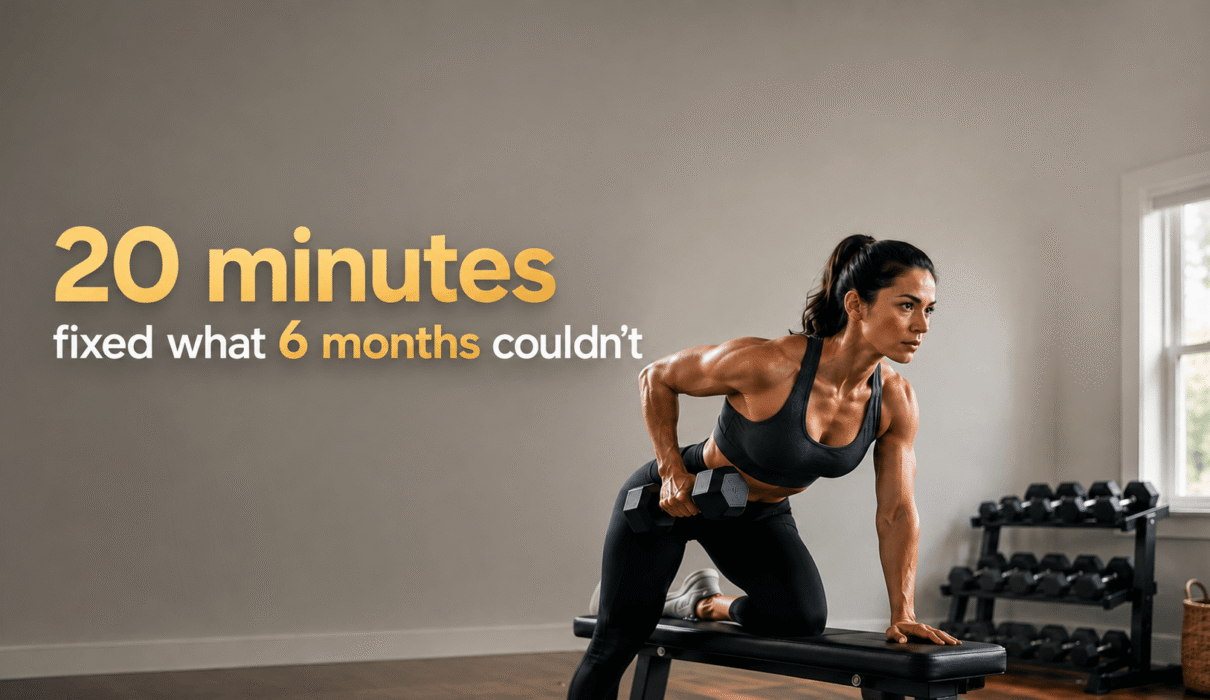
I almost gave up on dumbbell workouts because six months of the same routine had quietly stopped working. Equipment was never a problem. The missing piece was progressive overload, the planned habit of adding slightly more weight or a few more reps over time. Once I reduced my sessions to 20 minutes and increased weekly, the plateau was broken within about three weeks.
Six months in, I was ready to sell my dumbbells on Facebook Marketplace.
Not because I hated them. Because I was doing everything right, or so I thought, and nothing was happening. The same fifteen-pound pair. Three sets of ten each. The same forty-five minutes, five days a week. My arms looked exactly the same as they did in March. There had been no change in my strength numbers for several weeks. I remember standing in front of the mirror one Tuesday night with dumbbells in my hands and thinking this is not working for me.
If you’ve searched for anything about whether dumbbell workouts actually build muscle, or whether a short session could possibly be enough, I think you’re standing in a version of the same spot right now. so before you box up your weights, let me tell you what really changed things for me, because it wasn’t much effort. it was less, done differently.
Why my dumbbell workouts stopped working
Here’s the uncomfortable truth I avoided for months: My body had simply adapted to what I was asking of it, and I never asked for anything more.
Muscles only grow or become stronger when they are consistently challenged a little more than they are used to. Trainers call this progressive overload, and it is one of the most well-documented principles in strength training. Without it, your workouts stop being a motivation and start becoming maintenance, which is a very different thing from progress.
The National Academy of Sports Medicine explains this clearly: Without gradually increasing your demands on the muscles, growth slows, and if the load actually decreases over time, you may even lose the strength you’ve built. That was me. Same weight, same reps, month after month, while silently assuming consistency alone will keep producing results.
This was not a dumbbell problem. This was a planning problem.

The 20-minute fix that really moved the needle
Once I understood the real problem, I stopped trying to fix it by adding more. More sets, more exercises, more time on my feet. Instead, I cut the entire routine down to 20 minutes and rebuilt it based on three rules I was ignoring.
First, fewer exercises, done heavier. I reduced my routine from nine moves to four or five compound lifts that worked multiple muscle groups at once, and I picked up weights that made the last two repetitions really hard.
Second, a written log. I started tracking every set on my phone, which seems unnecessary until you realize you can’t apply progressive overload to a workout you don’t remember.
Third, weekly increases, planned in advance. Instead of waiting until I felt ready, each week, I either added a small amount of weight or added one or two extra reps per set.
None of these required much time in my day. If anything, cutting unnecessary stuff from my sessions was what made real work possible in the first place.
What a focused 20-minute dumbbell workout actually looks like
A typical session now starts with a two-minute warm up, then moves straight into compound lifts, goblet squats, dumbbell rows, overhead presses and Romanian deadlifts, performed as straight sets with minimal rest between them.
I’m not chasing exhaustion. I’m chasing a controlled, challenging stimulus that I can track and beat over the next week. If you want an in-depth analysis of upper body composition, I’ve put together a full approach in my push day workout guide and my pull day workout guide, both of which use the same progressive, compound-first thinking that ultimately works for me.
For anyone whose back and biceps have become as stagnant as mine, I’d also like to point you to my best back exercises with dumbbells Because a stalled back is often the quietest plateau of all, it’s easy to overlook because it doesn’t show up in the mirror the way arms or chest do.

Why less time worked better than more
This is the part that surprised me the most. I expected that cutting back on workouts would slow down my progress. Instead, it did the opposite, and once I saw why, it made complete sense.
The CDC’s physical activity guidelines recommend just two concentrated days a week of muscle-strengthening activity across all major muscle groups. Two. Not five, not every day, not an hour-long marathon. I was training far more often than necessary, at too low an intensity to justify the extra time, which is close to the worst combination for real progress.
Shorter sessions forced me to work intentionally on every set instead of long workouts on autopilot. There was no room left for unnecessary movement, so every rep had to count.
Three weeks in, here's what changed
I didn’t expect fast results. The six-month stalling had made me really skeptical of any improvement, including my own solution.
But by the third week, my goblet squat weight had doubled. My dumbbell rows felt more controlled rather than unstable on the final repetition. And for the first time in months, I left a workout feeling like I actually did something, rather than just exercising.
The physical changes came slowly, with about six weeks before I looked at anything in the mirror. But that plateau, the flat, stuck feeling that almost made me give up, broke almost immediately when the plans changed.

If your dumbbell workouts have stalled too
If this sounds familiar, the solution probably isn’t buying heavier dumbbells or finding a brand new routine on Pinterest. It’s probably simpler than that: Track your sets, plan a small weekly increase, and trust that a focused 20 minutes can perform better than an unfocused 45.
If your schedule is a real hindrance rather than a motivation, my weekend workout guide is built around the same short, high-intention approach. And if your upper body feels particularly stuck, my upper body strength training workout explains how I structure the progression from the waist up in more detail.
I am not a coach, and this is not a program written for everyone. This is actually what took me out of spinning my wheels for six months, and if you’re standing where I stood, it might be worth twenty minutes of your week to find out if it does the same for you.
