

 By
Most people starting calisthenics see a similar imbalance within a month: their chest looks strong and their shoulders feel active, while their back seems as though it has been completely neglected.
Fixing the leg issue was easy, and I have covered that in my calisthenics leg workout. The back issue is trickier because, in almost every bodyweight exercise, you are pushing away from the ground rather than pulling towards yourself.
Here is the short version: a calisthenics back workout trains your back through pulling movements and spinal stabilization. Therefore, it requires something to pull against, as well as exercises that can be performed on the ground at no cost. The seven exercises listed below meet both these requirements.
Why your back gets left behind in calisthenics
Push-ups, dips, and planks dominate bodyweight training for a simple reason: the ground is always there to push against, whereas there isn’t always something to pull on. Furthermore, your back is behind you, out of sight of the mirror and out of mind. A fatigued chest makes itself felt; a neglected back simply allows the shoulders to roll forward without protest.
Classic routines such as those I describe in my guide to military calisthenics, rely on push-ups, sit-ups, and running. This shows you where most bodyweight training focuses its attention, and where imbalances tend to arise.
What a strong back actually does for you
Your back is not just a single muscle. Large, wing-shaped latissimus dorsi (lats) muscles pull your arms down and back, muscles in the mid-back squeeze your shoulder blades together, and long muscles running along the spine help you stand upright.
Strengthening these three muscle groups makes everyday tasks such as carrying groceries or sitting for long periods while working easier. While strong muscles won’t magically fix your posture, weak muscles make slouching feel natural. Harvard Health recommends bodyweight exercises like bridges, side planks, and Superman as a practical starting point for building back strength.
The 7 moves that make a calisthenics back workout work
These can be divided into three groups. Pulling exercises build actual strength, floor exercises increase spinal endurance, and wall exercises develop proper shoulder alignment, upon which good posture depends.
Pulling exercises, which require a bar or a sturdy support:
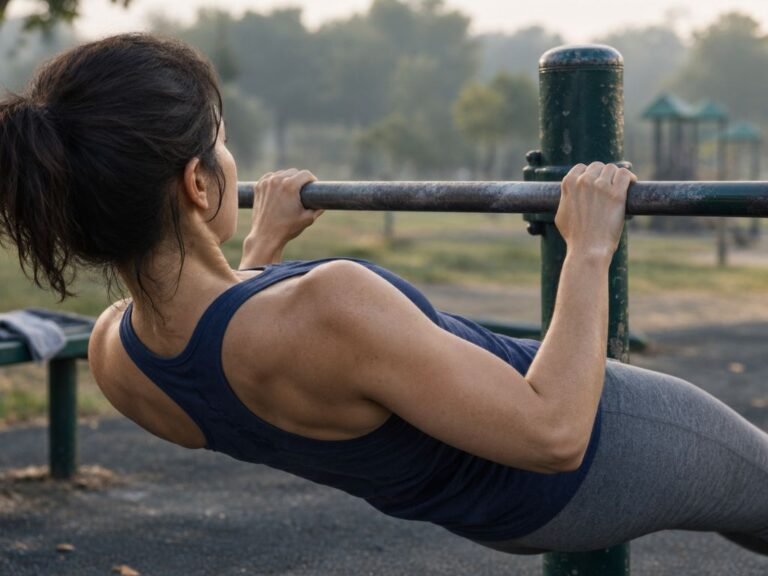
- Scapular pull-up: Hang from a bar with straight arms and move only your shoulder blades down and together. This teaches the initial phase of a pull-up.
- Pull-up or slow negative: Jump or step up to the top position, then lower yourself over four to five seconds. Negative exercises build strength for full repetitions.
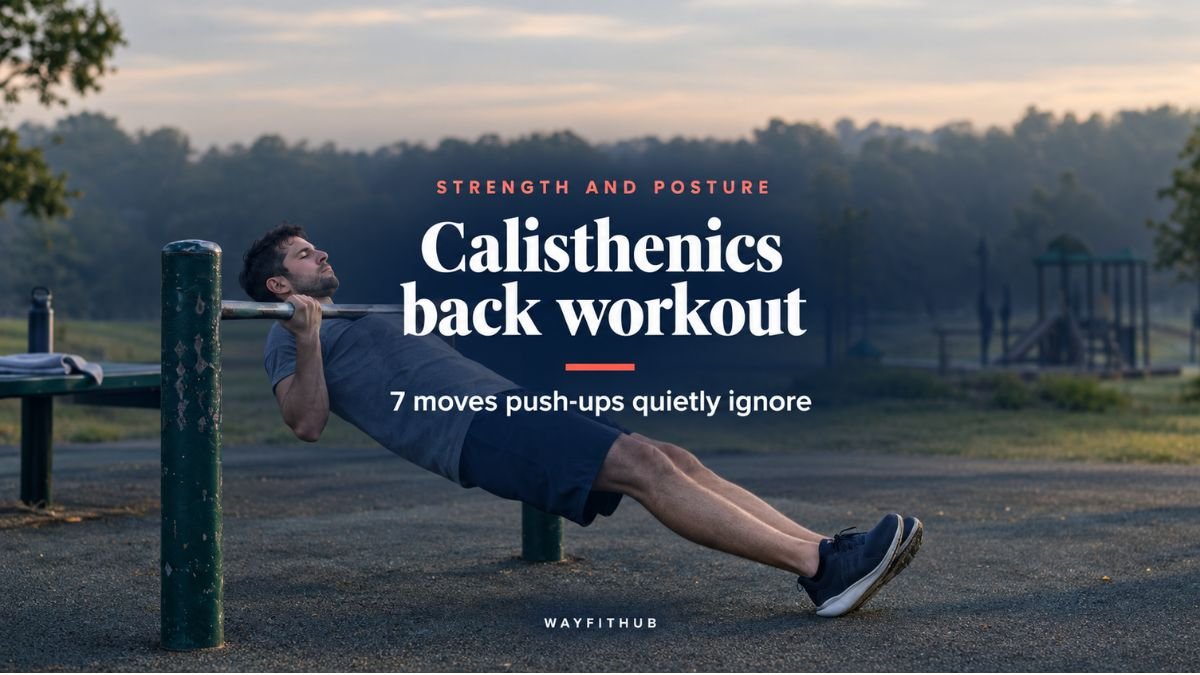
- Inverted row: Lie under a low bar or a very sturdy table, grasp the edge, and pull your chest toward it while keeping your body straight. Ensure that whatever you are using can support your weight and will not tip over.
Floor exercises, which require no equipment:
- Superman: Lie on your stomach and lift your arms and legs simultaneously; hold the position at the top for two seconds.
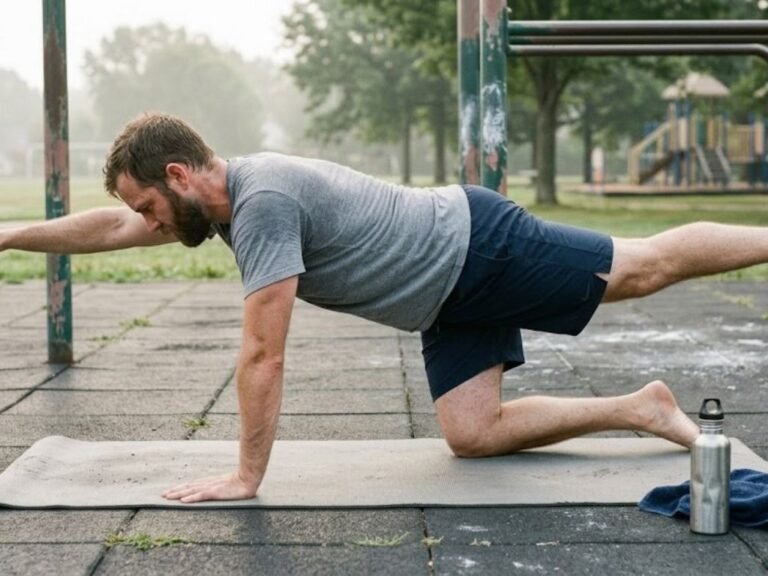
- Bird-dog: Get on all fours; extend one arm forward and the opposite leg backward while keeping your hips stable.
- Prone Y-raise: Lie on your stomach, position your arms in a ‘Y’ shape, point your thumbs toward the ceiling, and squeeze your shoulder blades together.
Wall-based exercise:
- Wall angel: Stand with your back against a wall and slide your arms up and down in a snow angel motion, ensuring your lower back and arms do not lose contact with the wall.
If you also train with weights, my pull day workout guide covers the loaded versions of these same pulling patterns.
The wall angel is a quiet favorite of mine for the same reason my free wall Pilates workout works, a wall gives you instant feedback on where your body really is.
No pull-up bar? Here is the honest answer
Floor-based exercises remain beneficial. They build the stamina of the muscles that keep you upright, and they require only a small amount of space on the floor.
However, they do not develop pulling strength in the same way that rows or pull-ups do. At some point, you will inevitably need something to pull against, whether it is a properly installed bar, a bar at a park, or a sturdy table for performing rows.
A calisthenics back workout to try this week
The Mayo Clinic’s core-strength guide includes exercises such as the ‘Superman’ and ‘Bird-Dog.’ It advises individuals with back problems or osteoporosis to consult a healthcare professional before starting.
Warm up with ten ‘Wall Angels’ and eight ‘Scapular Pull-ups.’ Then, perform three rounds of the exercises listed below, resting for 60 to 90 seconds between rounds:
- Pull-ups or slow negatives: 3 to 5 reps
- Inverted rows: 8 to 10 reps
- Superman: 10 reps (hold for two seconds)
- Bird-Dog: 8 reps per side
- Prone Y-raise: 8 reps
Stop each set if your form begins to deteriorate. Swinging the body or shrugging the shoulders while performing back exercises can easily lead to cheating, and reps performed with poor form result in training the wrong muscles.
Where this leaves you
The push aspect was never the problem; the problem was only pushing.
Incorporate a calisthenics back workout into your existing routine; this will provide a counterbalance to your push-ups. All you need for this are seven moves, a bar, and a little floor space.
FAQs
Can you build a strong back with calisthenics alone?
Yes, as long as you have something to pull against. Pull-ups and rows do the main work, and floor-based movements support them.
How often should you do a calisthenics back workout?
For most people, exercising two to three times a week is beneficial, and a rest day between sessions is also essential to allow muscles to recover.
Can it improve my posture?
A strong back makes it easier to maintain good posture, but it is not a cure for pain or medical conditions. If you are experiencing persistent pain, consult an expert.
What if I cannot do a single pull-up?
Start with scapular pull-ups, slow negatives, and inverted rows where your body remains more upright; this makes the rowing motion easier. As you get stronger, lower your body closer to the floor.
.
