


 By
Quick answer
Is Pilates a high intensity workout? For most people, most of the time, no. A typical Pilates class focuses on strength and control, rather than on workouts designed to significantly elevate your heart rate. This does not mean it is easy. Muscular exertion and cardiovascular exertion are two different things, and Pilates primarily emphasizes the former. There is, however, a version of Pilates that comes quite close to a high-intensity workout which I will cover further below.
Is Pilates a high intensity workout? What your heart rate really says
You finish a Pilates class; your abs are trembling, and there’s sweat on your forehead. Yet, your watch suggests you’ve barely burned any calories.
So, who’s telling the truth, your body or your watch?
The answer depends on how you define “high intensity” and the specific type of Pilates you’re doing. I’ve gathered the research so you can evaluate your own workout sessions. If you’re also curious about HIIT and barre, I’ve included both in this comparison alongside my own full-body workout comparison.
What high intensity actually means
The CDC follows a simple rule: during moderate-intensity activity, you can talk but not sing. During vigorous-intensity activity, you can only say a few words before needing to take a breath. To gauge intensity, this guideline also uses a 0-to-10 effort scale, where vigorous activity begins at approximately 7 or 8.
This scale is relative. a pace that feels vigorous to one person might feel moderate to someone who is more physically fit. HIIT adds a specific structure to this. The Mayo Clinic describes interval training as short bursts of vigorous activity interspersed with periods of rest.
Therefore, when people ask whether Pilates is a high-intensity exercise, they are usually asking two things: Is it difficult, and does it elevate your heart rate into the vigorous-intensity range? These questions have different answers.
What research says about Pilates and heart rate
One of the most well-known studies comes from the American Council on Exercise. Participants completed two 50-minute mat sessions, one for beginners and one for advanced practitioners, while researchers monitored their heart rates and oxygen consumption. The full results are publicly available.
In the beginner routine, the heart rate averaged about 54 percent of the maximum heart rate, while in the advanced routine, it reached approximately 62 percent. For the purpose of improving cardio fitness, this study used a range of 64 to 94 percent as a benchmark and both levels fell below this range. Calorie expenditure was also relatively modest, approximately 175 calories were burned during the beginner session, and 254 calories during the advanced session.
A 2005 analysis in the IDEA Fitness Journal showed a similar pattern. During intermediate and advanced mat workouts, the heart rate averaged between 120 and 130 beats per minute. However, certain challenging exercises, such as the jackknife and side lift, did manage to push the heart rate into the target zone. The same report noted that maintaining continuous activity with minimal breaks is key to keeping the heart rate elevated.
These findings should be viewed as a general indication rather than a definitive conclusion. Both studies are over 20 years old, focused exclusively on mat-based routines, and heart rate responses can vary based on an individual’s personal fitness level. Nevertheless, it remains true that Pilates tends to challenge the muscles more than it challenges your heart.
How different types of Pilates compare
Not every class feels the same, so here is a quick way to place yours.
| Pilates format | Typical intensity | What drives it |
|---|---|---|
| Beginner mat class | Low | About 54 percent of max heart rate in the ACE study |
| Advanced mat class | Low to moderate | About 62 percent in the same study, with spikes on harder moves |
| Reformer class | Varies | Spring load, tempo, and how long the rest breaks are |
| High intensity Pilates or Pilates HIIT | Moderate to vigorous | Intervals, faster pace, and short rests |
| Hot Pilates | Varies | Heat lifts heart rate on its own, so judge by effort, not heart rate alone |
Is Pilates cardio?
Not in itself. Pilates is excellent for core strength, control, and mobility, and it can be considered a light-to-moderate intensity activity.
It begins to function like cardio when you engage in continuous movement with only brief breaks, and the pace is sufficient to alter your breathing rate. If you are still able to sing while performing the exercises, then the level of exertion does not yet qualify as cardio.
According to public health guidelines, adults should engage in moderate-to-vigorous aerobic activity each week. A light Pilates routine alone may not be sufficient to meet these requirements; however, incorporating activities such as brisk walking, cycling, or interval training would fulfill them.
What is Pilates HIIT?
Pilates HIIT, often marketed as High-Intensity Pilates or Power Pilates is a fusion of both disciplines. It incorporates core Pilates principles, such as controlled breathing and torso stability, combined with fast-paced, strenuous exercises interspersed with brief rest intervals.
Classes vary significantly. Some utilize reformer springs and heavy weights, with short periods of rest, while others integrate mat work with movements like planks, standing exercises, and bursts of cardio.
Hot Pilates takes place in a heated room. Since heat naturally elevates your heart rate, a high heart-rate reading does not necessarily mean you have exerted more effort. If you have any heart or blood pressure-related conditions, consult your doctor before exercising in high-heat environments.
So, is Pilates considered HIIT? Traditional Pilates is not HIIT; however, a class structured around intervals can be classified as HIIT.
How to make Pilates harder without losing form
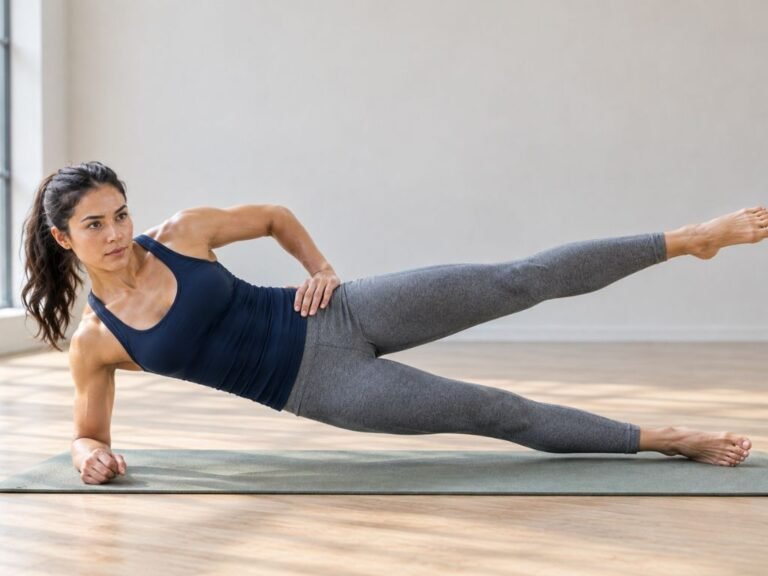
You do not need a new class to raise the intensity of a mat session. You need less rest and a better flow. If you want a gentler starting point first, try our free wall Pilates workout. Start by performing the Hundred exercise for one minute, then transition directly into a slow roll-up without pausing. Follow this with the single-leg stretch and criss-cross exercises; ensure that your lower back remains stable throughout.
Next, move into a plank position and rhythmically bring your knees toward your chest for 30 seconds. Then, perform a side plank (on both sides) while supported on your elbows, and finally, execute lunges in a slow, controlled manner. Rest for 15 seconds, then repeat the entire circuit three to four times. Your breathing should become intense enough that you find it difficult to speak without pausing.
You can also increase the muscular intensity—which is distinct from cardiovascular exertion. By slowing down the movements, holding positions for longer, or using resistance bands or ankle weights, you can make these exercises more challenging without significantly raising your heart rate.
If your form begins to falter, slow down your pace. Performing exercises quickly with poor form can lead to injuries or muscle strains rather than providing any benefits. If you have any joint, back, or heart-related conditions, or if you are pregnant, be sure to consult your doctor before beginning any exercise routine.
Is barre considered HIIT?
This is generally not the case. Barre involves small, controlled movements and holding positions for extended periods; therefore, the burning sensation you feel is primarily in the muscles.
Some studios incorporate cardio or interval blocks, which can elevate your heart rate. However, a typical class does not follow the pattern of high-intensity exertion followed by recovery, a structure that is the defining characteristic of a HIIT workout.
If you would like to compare Barre, Pilates, and HIIT to understand how they differ, I have provided a detailed explanation.
How to check the intensity of your own Pilates session
Start with the talk test. If you can sing, it means you are exerting yourself lightly. If you can talk but cannot sing, you are exerting yourself at a moderate level. If you can only manage to say a few words, you are exerting yourself too intensely.
Next, rate your level of exertion on a scale of 0 to 10. A level of 7 or 8 indicates the beginning of very intense exertion.
If you wear a heart rate monitor, use it only as a rough guide. During exercises like planks, where you put pressure on your hands, wrist-based sensors may be less accurate. Your level of exertion and your breathing pattern can provide a better indication of your intensity than the numbers displayed on your wrist.
When Pilates is the right choice even if it is not high intensity
Not every workout needs to be high-intensity. Pilates is excellent for core control, posture, mobility, and low-impact movement. If these are your priorities, then maintaining a lower heart rate during your workout is not a drawback.
If you also want to improve your cardio fitness, consider adding a separate session, once or twice a week of brisk walking, cycling, or interval training.
In short, choose your workout based on the results you wish to achieve.
