

 By
It’s 3:00 PM, and for no apparent reason, you feel a tightness in your chest.
Your mind is racing, your shoulders are hunched up toward your ears, and the last thing you want right now is a workout routine. The good news is that you don’t need a formal plan, a gym, or an entire hour. There are excellent exercises to help reduce anxiety that take less than 10 minutes, and you can start them right where you’re sitting.
Anxiety isn’t just a mental experience; it’s a physical response, your heart rate quickens, your breathing becomes shallow, and your muscles tense up. Moving your body and practicing slow, controlled breathing can directly influence your physical state. This is why, when simply being told to “just relax” doesn’t work, these exercises for anxiety often prove effective. In my previous guide on deep breathing exercises for lowering blood pressure, I covered various breathing methods; this article builds on that by offering seven ways to use physical movement to ease tension.
A quick note before we begin: I am a fitness enthusiast, not a doctor or a therapist. Please consider this practical advice regarding physical activity, rather than medical treatment. You will find a more detailed disclaimer at the end of this article.
Why exercises for anxiety work when your body feels like an alarm
When something appears dangerous, your body releases adrenaline and cortisol; your heart rate quickens, and your breathing becomes rapid and shallow. This response is useful if, for example, a car is heading toward you. However, if this same response is triggered simply by seeing an email, it can be quite distressing. Exercise provides an outlet for this stress response. It helps reduce the tension accumulated in the body, enables you to take deeper breaths, and allows your body to practice experiencing an elevated heart rate and subsequently returning to a resting state.
Research findings are encouraging. A major 2023 review published in the British Journal of Sports Medicine, which encompassed 97 other reviews, over 1,000 trials, and approximately 128,000 adults found that physical activity has a significantly positive impact on symptoms of anxiety compared to standard care. Two key findings emerged: higher-intensity activities yielded better improvements, and programs lasting 12 weeks or less proved to be the most effective. In simpler terms, you do not need to wait a year to determine whether this approach is working for you.
The benefits of strength training have also been demonstrated. A 2017 meta-analysis published in Sports Medicine examined 16 randomized trials involving 922 participants. Individuals who engaged in weight-training exercises two to five days a week for an average of about 11 weeks showed lower levels of anxiety regardless of whether or not they had a previously diagnosed medical condition. However, this review does not claim that weight training is superior to other forms of exercise; it simply indicates that it is indeed helpful.
The 7 best exercises for anxiety, from a 2 minute reset to a full workout
I have ordered these from fastest to most involved. Use the first few when you are mid spike, and save the later ones for your regular routine.
1. Slow breathing with a long exhale
This is the fastest reset method I know. You can think of it as a form of exercise, as it trains both your breathing process and your ability to remain calm.
Sit or stand upright and inhale through your nose for about four seconds. Ensure that your shoulders do not rise while inhaling; instead, your abdomen should expand. Then, exhale slowly through your mouth for six to eight seconds, much like how you might fog up a mirror with your breath. Continue this process for two to five minutes. According to Harvard Health, slow breathing defined as taking about six to ten breaths per minute, with a slow and steady exhalation is an excellent way to calm the nervous system.
If you feel dizzy, reduce the count and allow your breathing to return to normal for a while. The goal is to achieve a state of calm, not to turn breathing into a competition.

2. A brisk 10 minute walk
Walking might seem the least exciting activity on this list, but it could well be the most beneficial. All it requires is a pair of shoes.
Maintain a pace that allows you to hold a conversation, but not to sing. Let your arms swing naturally, keep your gaze fixed on the horizon ahead, and take note of everything you can see, hear, or smell. This subtle shift in focus draws you out of the world of your own thoughts and connects you to your immediate surroundings, whether on a street or in an outdoor space.
The Anxiety and Depression Association of America (ADAA) notes that even just five minutes of aerobic exercise can help reduce anxiety. According to HealthDay, a practical piece of advice is this: rather than waiting for a perfect two-hour window, simply go for a 15-minute walk right now.

3. The tension and release shake-out
Anxiety often settles in the jaw, neck, shoulders, and hands. This technique addresses all these areas in less than two minutes.
Stand up and tense every part of your body simultaneously for about five seconds: clench your fists, tighten your forearms, pull your shoulders up toward your ears, clench your jaw, and tense your hip muscles and toes. Then, release everything and shake out your hands, arms, and legs for twenty seconds. Repeat this three times.
It may look a bit strange, but it feels wonderful. This shift teaches your body what it truly feels like to be “relaxed ” a state that is difficult to perceive when you are under stress.
4. Strength training
If I had to choose a regular exercise routine for a stressful week, I would pick weightlifting. It is structured, helps keep the mind calm, and leaves very little room for carelessness when it comes to sets and repetitions.
You don’t even need a barbell for this. Exercises like squats, push-ups (done against a wall, on a counter, or on the floor), dumbbell rows, glute bridges, and planks provide a full-body workout. Perform two to three rounds of eight to twelve repetitions each, taking a one-minute rest between exercises.
Choose a weight that feels challenging during the final two repetitions, but ensure your form never falters. Research indicates that two to five sessions per week are beneficial, so two solid sessions make for a great start. If you are looking for a complete routine, you can find one in my strength training guide for a toned body.

5. A slow yoga flow
Yoga combines movement with breathing, which is highly beneficial when experiencing shortness of breath due to anxiety.
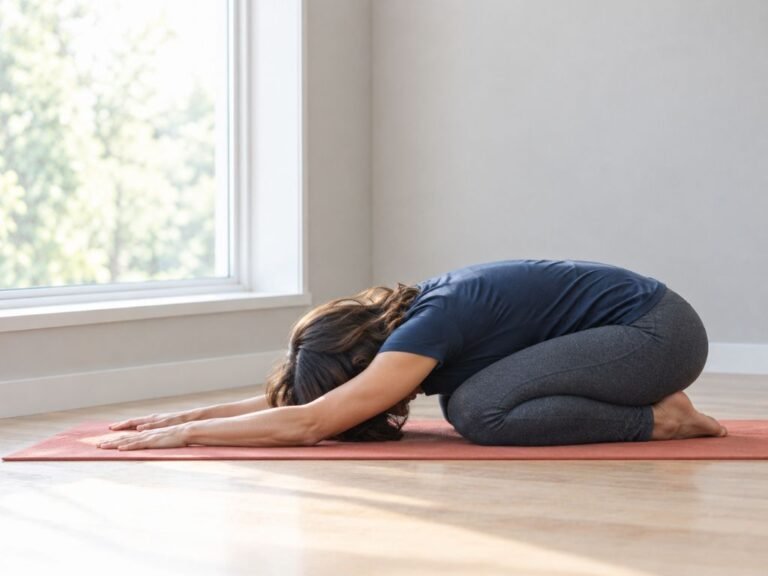
Try a ten-minute yoga routine: perform eight slow cycles of the Cat-Cow pose, rest in the Child’s Pose for five breaths, practice a low lunge on each side, perform a forward fold with a slight bend in the knees, and finally, lie on your back for two minutes. Ensure that each exhalation lasts slightly longer than each inhalation.
An article in Psychology Today by therapist Amy Morin notes that studies link yoga to stress reduction; some research even suggests that it increases a calming brain chemical called GABA. While scientific understanding of this is still evolving, the practice is gentle, inexpensive, and easy to try.
6. Rhythmic cardio you can zone out to
Cycling, swimming, rowing, dancing in the kitchen, or a gentle jog on flat ground, engaging in repetitive physical activity gives a busy mind something to focus on, helping it find stillness.
Try to exercise for 20 to 30 minutes, perhaps while chatting with someone. The ADAA’s guidance on exercise, stress, and anxiety emphasizes enjoyment and consistency; so, choose your favorite music or a podcast, or invite a friend to join you. If you experience knee or joint pain, my guide to low-impact cardio offers accessible alternatives that still effectively raise your heart rate.
7. Short intervals, added carefully
The review mentioned above suggests that higher-intensity workouts can be more beneficial, which is why intervals are significant. After a thorough warm-up, perform an intense exercise for 30 seconds, followed by 90 seconds of lighter activity; repeat this cycle 6 times.
However, there is an important point to keep in mind: during intense exercise, a rapid heartbeat and heavy breathing might make you feel as though you are panicking, a sensation some people prefer to avoid. Increase the intensity of your workout gradually. Maintain an intensity level that still allows you to speak a short sentence; if you begin to feel fearful rather than empowered, stop immediately.
If you are curious about how different workout formats compare, I have provided a detailed explanation in my HIIT, Pilates and barre full body workout comparison.
How much exercise do you need for anxiety relief?
Start with something so small that it feels almost insignificant. Even ten minutes count.
According to suggestions from the ADAA, compiled by HealthDay, one should aim for 30 minutes of exercise on most days. Rather than doing one long workout, it is often better to break it up into several shorter sessions. Also, keep in mind that it typically takes four to eight weeks for a new routine to start feeling comfortable. Think of this goal as an upper limit to work toward gradually, rather than a standard you must meet by tomorrow. Do a little something every day, aim for a few proper workouts throughout the week, and be patient with yourself during the first month.
There are two types of benefits to this: a single session can help reduce stress or distress that very same day, while regular exercise over the course of several weeks helps improve your overall physical baseline.
A simple week of exercises for anxiety
Here, I will organize these exercises into a weekly schedule that feels manageable. You are free to adjust the days as you prefer.
On Monday, complete a full-body strength training session lasting about 30 minutes. On Tuesday, go for a 20–30 minute brisk walk, ideally outdoors. On Wednesday, practice yoga, and spend a few minutes doing slow, deep breathing exercises before bed. On Thursday, do another strength training session, or opt for some rhythmic cardio if you are feeling tired. On Friday, go for a walk or a bike ride while listening to your favorite music. On Saturday, you can do some interval training, or perhaps enjoy a long, leisurely walk with a friend. On Sunday, take a rest, and include a five-minute breathing exercise along with a shake-out to help release tension.
On any day when your anxiety levels rise, replace your scheduled workout with a breathing exercise, a shake-out, or a ten-minute walk. Even a shorter session is perfectly fine.
When exercises for anxiety are not enough, and what to watch for
Exercise is a powerful tool, but it is not a substitute for professional care. If anxiety is interfering with your work, sleep, relationships, or daily life, consult a doctor or a licensed mental health professional. Exercise can be effective when combined with therapy and, if necessary, medication.
It is important to be aware of certain precautions. Pre-workout drinks high in caffeine or other stimulants can cause a rapid heartbeat; consider trying a workout session without them. If you find yourself exercising despite an injury, or feeling anxious about skipping a session, it is best to discuss this with a professional. Sudden chest pain, fainting, or difficulty breathing, especially if these are new symptoms, require medical attention, not breathing exercises.
Final thoughts
Anxiety can arise at any time. If you have a few practices ready to go, you won’t have to struggle with it from scratch every single time.
Choose one from this list and try it out this week. The next time you feel a tightness in your chest, you’ll already know where to begin.
