

 By
By Somewhere right now, someone is skipping their back workout because they don’t have a pull-up bar. Maybe that someone could be you.
It’s an easy belief to fall into. Every workout video starts like this. Grab the bar, hang, pull. If you haven’t installed a single bolt on the door frame, the entire session could be off the table before it even starts.
Here’s the problem with that belief. It is wrong.
A back workout with bodyweight works differently than weighted workouts, not worse. The muscles that make up your back, your lats, traps, rhomboids and erector spinae respond to tension and time under strain. They don’t care whether that tension comes from the barbell or the angle of your body against gravity.
This guide walks you through nine bodyweight back exercises that prove exactly that, along with a simple routine for stringing them together. No stop. No gym membership. Just a door frame, a towel, and about twenty minutes.
Why the bodyweight workout back myth sticks around
The myth isn’t really about back training. It’s about the equipment. Somewhere along the way, back day became synonymous with the pull-up bar, and if you didn’t have access to one, the perception was that your back workout would have to wait.
Researchers at Harvard Health reviewed the evidence on bodyweight exercise and found that it builds muscle “independent of external load.” In one small study they cite, ten weeks of bodyweight-only training improved seven of nine fitness measures tracked by researchers, including a meaningful jump in core endurance. Your back is a muscle group like any other. It reacts on the same principle.
If you only have access to a bar occasionally, our pull day workout guide explains how to build a complete pulling session around it. But you don’t need that to make meaningful progress today, and that’s the whole point of bodyweight workout back routines like this one.
Can you actually build a bigger back without weights?
Short answer, yes. Long answer, it depends on how you apply the resistance.
With barbells, you get stronger by adding weight to the bar. With your body, you become stronger by manipulating leverage, tempo, and range of motion. Fitness professionals certified through organizations such as the American Council on Exercise design entire resistance-training phases this way, progressively increasing training overload through exercise selection, tempo, and rest intervals rather than external load alone.
This is the exact same toolkit that this workout uses. If you want a deeper look at how isometrics fits into that picture, our guide on how calisthenics combines isometric and isotonic exercises breaks down the difference, and it’s the exact equipment you’ll be relying on most in the routine below.
What muscles a bodyweight back workout actually trains
Your back isn’t one muscle, it’s a woven system of layers running from your neck to just above your hips. According to the Cleveland Clinic, these muscles form the main structural support for your torso, keep you stable, and help you maintain posture, whether you’re walking or sitting still. A well-organized body weight routine should affect most of them.
- Latissimus dorsi (lats): Large, wing-shaped muscles that provide width to your back.
- Trapezius: Runs from your neck to your shoulders, controls the movement and posture of the shoulder blades.
- Rhomboids: Sit under the traps and draw your shoulder blades toward your spine.
- Erector spinae: runs along your spine and supports posture and lower back stability
- Rear deltoids: The back of your shoulders, often neglected but essential for pulling strength
How to make bodyweight back exercises harder as you get stronger
The most common reason why bodyweight back workouts stop working is not due to lack of equipment. This is a lack of progress. If you do exactly the same repetitions, at exactly the same speed, in exactly the same position, every session, your back has no reason to continue to adapt.
Here are four ways to keep increasing the difficulty without adding a single plate.
- Slow down the tempo. A 3 to 5 second downward phase on any pulling or extension movement dramatically increases the time under tension.
- Add an isometric hold. Pausing for 2 to 3 seconds at the top of a row or extension forces the muscles to work harder to stay there.
- Change your leverage. By lowering the angle of your body into a line, or raising your legs, more of your body weight is transferred to the working muscles.
- Reduce your rest. Reducing the rest between sets from 90 seconds to 60 seconds increases the overall training density.
The 9 bodyweight back exercises
These nine exercises cover every major back muscle listed above. You will need a doorframe or sturdy table, a towel, and a bit of floor space. That is it.
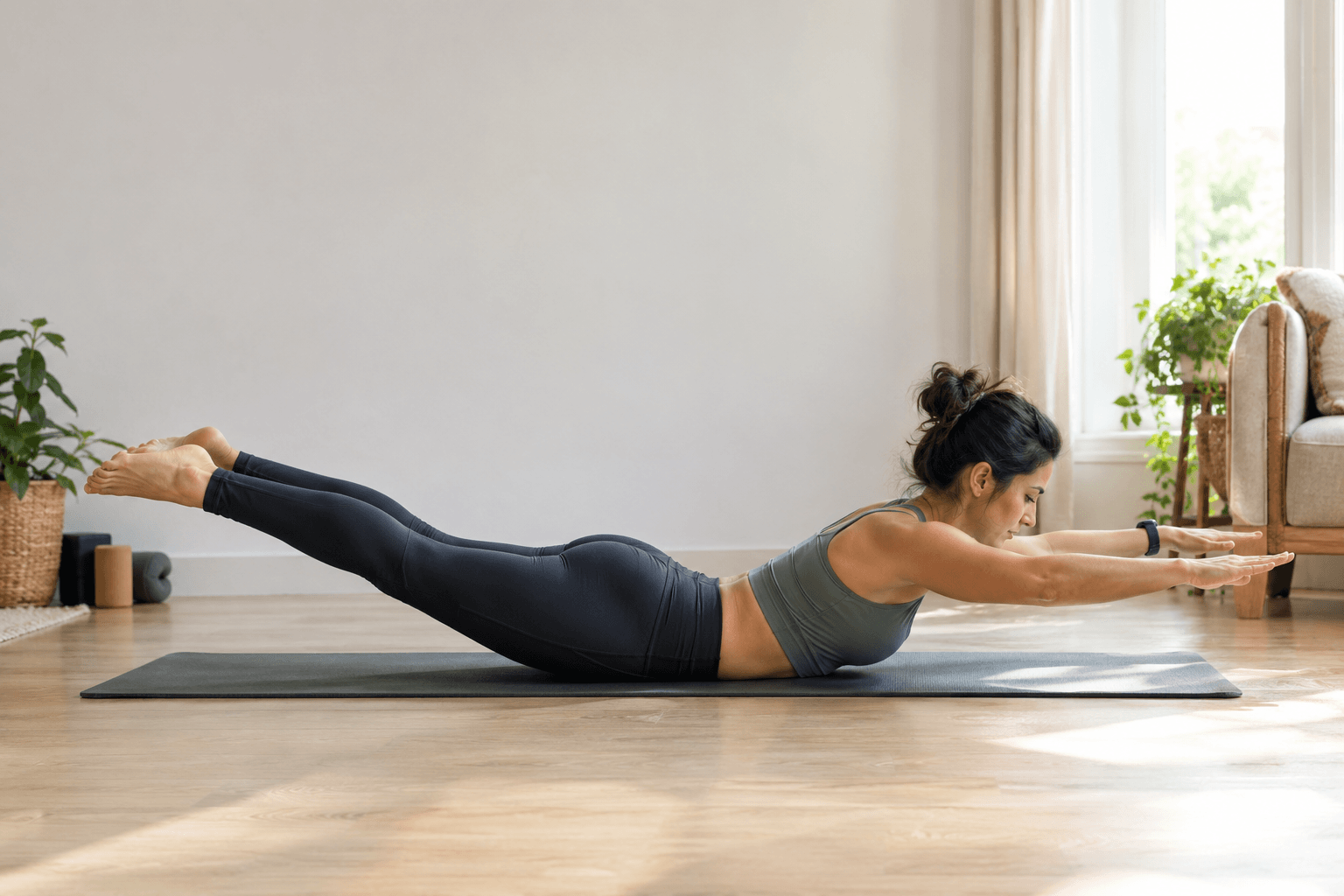
1. Superman
Lie face down with your arms extended in front of you. Lift your arms, chest, and legs off the ground at the same time, squeezing your lower back and glutes at the top. Hold for a second, then lower with control.
Do 3 sets of 10 to 12 reps. Add a 2 second hold at the top once the basic version feels easy.
2. Prone back extension
Lie face down with your hands lightly behind your head. Exhale as you lift your chest off the ground, pulling your shoulder blades together. Keep your neck neutral, do not crane it upward.
Do 3 sets of 12 reps. This is a gentler entry point than the Superman if your lower back is still building endurance.
3. Reverse snow angel
Lie face down with your arms at your sides, palms down. Sweep your arms up and out in a wide arc, like you are making a snow angel, squeezing your shoulder blades together at the top. Reverse the motion slowly on the way down.
Do 3 sets of 10 reps. This one hits your rear delts and mid traps directly, muscles that most bodyweight routines skip entirely.
4. Bird dog
Start on your hands and knees. Extend your right arm forward and your left leg back simultaneously, keeping your hips and shoulders square to the floor. Hold for 2 seconds, then switch sides.
Do 3 sets of 10 reps per side. It looks simple, but it builds the deep stability your erector spinae relies on during every other exercise on this list.
5. Scapular push-up
Get into a push-up position with your arms fully extended, no bend in the elbows. Without bending your arms, let your shoulder blades squeeze together and your chest drop slightly toward the floor, then push the floor away and round your upper back.
Do 3 sets of 12 reps. This isolates the muscles around your shoulder blades and builds the control you will need for the rows below.
6. Cobra hold
Lie face down, palms flat under your shoulders. Press through your hands just enough to lift your chest, keeping your hips on the floor and your shoulders pulled down and back, away from your ears. Hold, do not just push up and drop.
Hold for 20 to 30 seconds, repeat 3 times. This one is borrowed from yoga, and it is one of the most underrated upper-back exercises there is.

7. Wall walk
Start in a plank position with your feet against a wall. Slowly walk your feet up the wall while walking your hands closer to it, until your body is as close to vertical as you can control. Walk back down with control.
Do 3 sets of 4 to 6 controlled reps. This builds the upper-back and shoulder strength that eventually carries over to a real pull-up, if that is a goal down the line.
8. Furniture-assisted row
Sit on the floor facing a sturdy, heavy table or the underside of a countertop. Grip the edge, walk your feet forward, and lean back until your arms are extended. Pull your chest toward the edge, squeezing your shoulder blades, then lower with control.
Do 3 sets of 10 to 12 reps. The lower your hips, the harder the row. Test the sturdiness of whatever you are using before you commit your full bodyweight to it.
9. Towel row
Loop a sturdy towel over the top of an open door, close the door tightly, and hold one end in each hand. Lean back until your arms are extended, then pull your chest toward the door, driving your elbows back and squeezing your shoulder blades together.
Do 3 sets of 10 to 12 reps. This is the closest bodyweight substitute to a cable row you will find, and it is the exercise that convinces most skeptics this style of training actually works.
A simple back workout with bodyweight you can do today
You don’t need to do all nine exercises in every session. Move through this simple structure two to three times a week, with at least a day of rest between sessions to give your back time to recover. If you want to make it into a longer training block, our 30-minute bodyweight workout shows a way to fill that remaining time with filler movements.
- Warm-up: 5 minutes of gentle movement, arm circles, cat-cow stretch and a slow round of bird dogs
- Towel Row: 3 sets of 10 to 12 reps
- Reverse Snow Angel: 3 sets of 10 reps
- Furniture-assisted row: 3 sets of 10 to 12 reps
- Superman: 3 sets of 10 to 12 reps
- Cobra hold: 3 rounds of 20 to 30 seconds
To start, rest 45 to 60 seconds between sets. As the routine becomes easier, you are prompted to implement one of the above progression methods instead of adding more exercises.
Common mistakes that stall a bodyweight back workout
- Running through reps using momentum instead of a slow, controlled pace, which quietly shifts the work away from your back to your arms.
- Abandoning the isometric hold, which is often where most of the real muscle-building tension occurs
- Pulling with your arms first instead of leading with your shoulder blades, a habit that limits how much your back can actually contribute.
- Staying at the same difficulty for months without changing tempo, leverage, or rest is the biggest reason for stalling progress.
That last one isn’t unique to bodyweight training. This is the same wall that many lifters hit with external loads, too, and the solution is usually the same: change one variable at a time and give it a few weeks before assessing results. Our article on overcoming dumbbell workout plateaus goes through the same exact process if you eventually add weighted training to the mix.
